

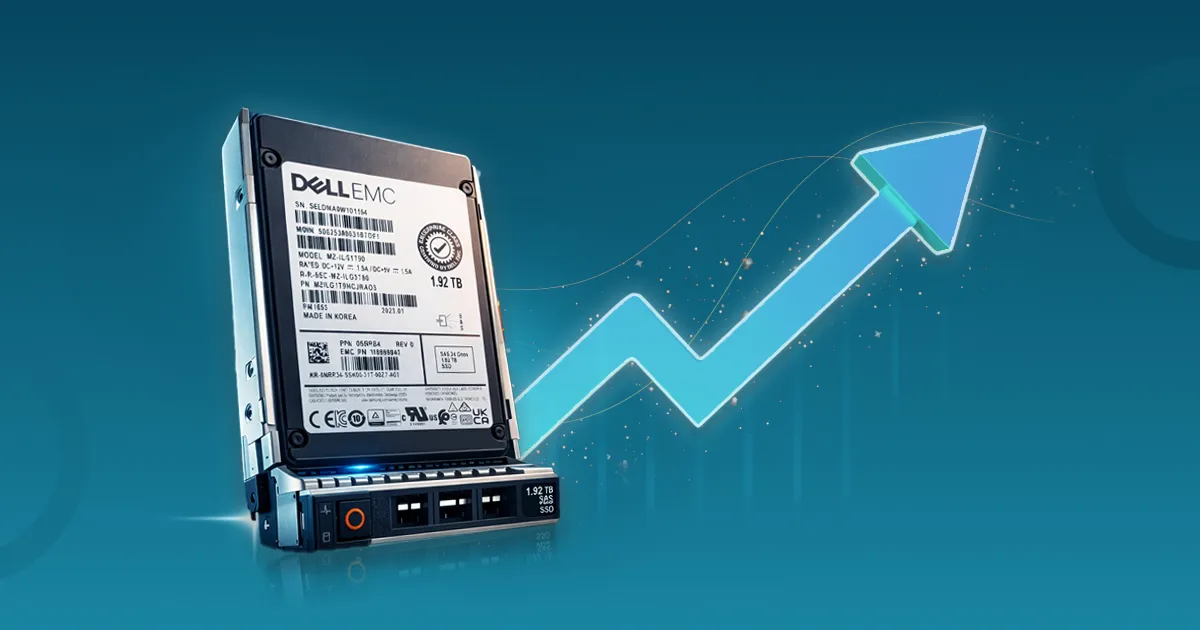
Enterprise storage budgets are under pressure in 2026 as server SSD pricing trends shift across the global infrastructure market. Enterprises managing modern data centers are experiencing noticeable changes in flash storage costs due to evolving supply dynamics, growing AI infrastructure demand, and more disciplined NAND production strategies.
For IT leaders and infrastructure planners, this creates a complex challenge. Organizations must control capital expenditure while still maintaining high-performance storage environments that support virtualization platforms, enterprise databases, and mission-critical workloads. Storage performance cannot be compromised simply because procurement costs are increasing.
Several structural market factors are influencing these pricing changes. Hyperscale data centers are consuming large volumes of enterprise NVMe drives, manufacturers are prioritizing higher-margin storage products, and NAND supply growth is being carefully managed after previous oversupply cycles.
As a result, enterprises need a more strategic approach to storage planning. Understanding the causes behind rising Server SSD prices and developing structured infrastructure strategies is essential to maintaining performance, stability, and long-term cost efficiency.
What Is Driving Server SSD Price Pressure in 2026
Understanding the pricing pressure is the first step before reacting to it. Many enterprises assume prices will “normalize soon.” But the current situation is more structural than cyclical.
NAND Production Discipline
In previous years, oversupply pushed NAND prices down aggressively. Vendors learned hard lessons from that cycle. In 2026, manufacturers are carefully managing wafer output. Production expansion is slower, more calculated, and focused on profitable segments.
This production discipline limits excess supply. And limited supply means stronger pricing power.
AI and Hyperscaler Consumption
AI workloads are not small experiments anymore. Large-scale AI training clusters require extremely high-performance NVMe Server SSDs with consistent throughput and endurance. Hyperscale data centers secure supply through long-term contracts.
When hyperscalers lock in inventory early, mid-size and traditional enterprises often face delayed availability and higher spot pricing. The demand imbalance becomes visible quickly.
Focus on High-Margin Enterprise Models
Vendors are prioritizing premium enterprise SSD models over entry-level drives. High-end NVMe drives, especially PCIe Gen4 and Gen5 variants, receive production priority. Lower-tier products sometimes experience extended lead times.
This selective manufacturing affects price stability across the entire Server SSD market.
Supply Chain & Component Constraints
Even though global logistics improved compared to previous disruptions, certain semiconductor components such as controllers and advanced packaging materials still create bottlenecks. Firmware validation cycles for enterprise drives are longer and more complex.
All these factors together create a pricing environment that is firm, not temporary.
Below is an approximate representation of enterprise SSD pricing trends over the last five years :
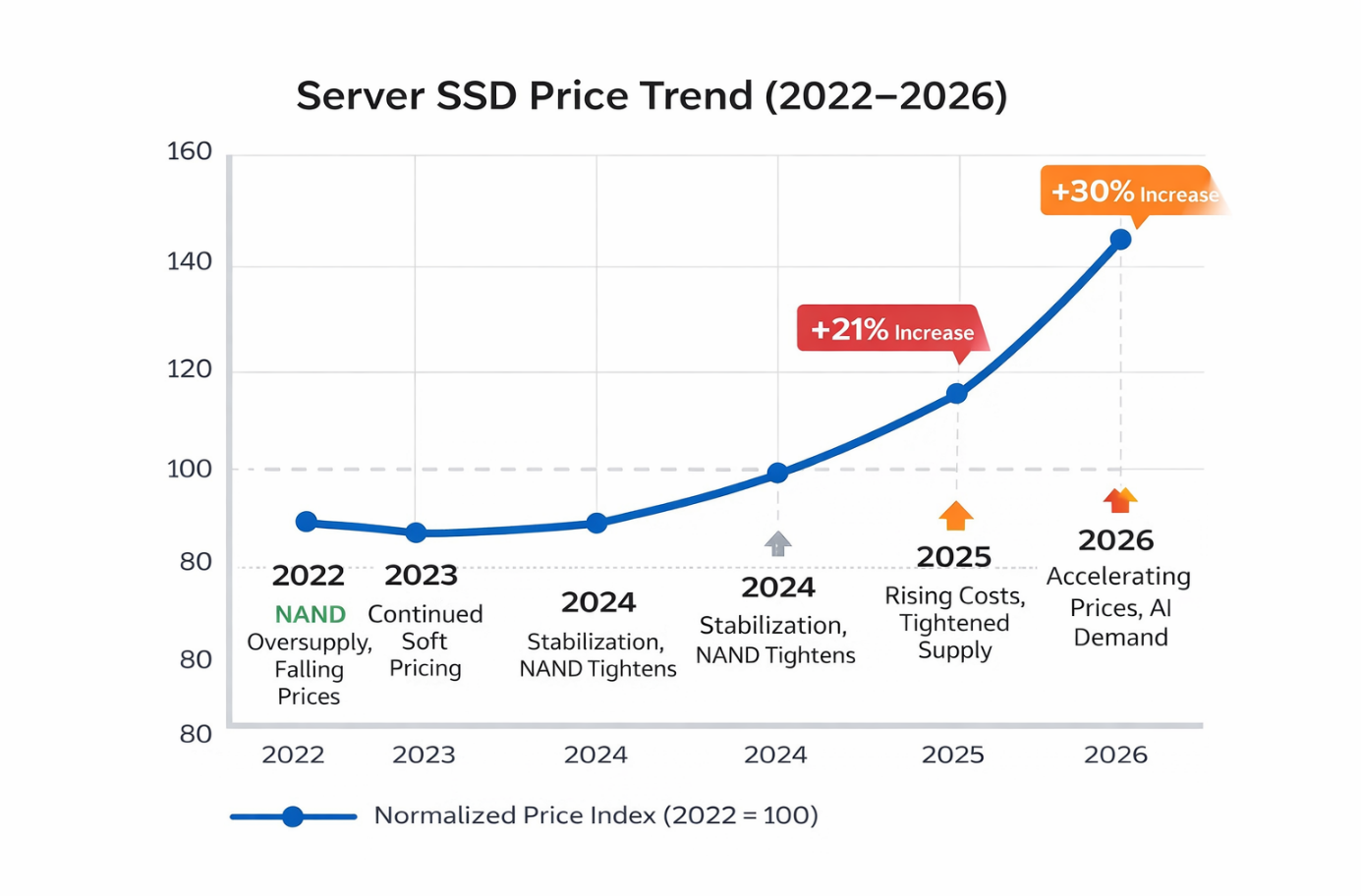
Source: Trend analysis based on industry reports from IDC, Trend Force, and enterprise NAND market insights (2022–2026).
Many enterprises built their cost assumptions based on 2024 pricing. 2026 is clearly a different scenario.
The Real Risk: Protecting Performance While Controlling Cost
When Server SSD prices increase, the immediate reaction is cost reduction. That reaction is understandable. But the real danger lies in making the wrong compromise.
Enterprise infrastructure cannot afford performance degradation. It’s not just about speed. It’s about operational continuity.
Impact on Virtualization Clusters
In VMware or Hyper-V environments, storage latency directly affects VM density. If latency increases due to lower-tier server SSD selection, fewer virtual machines can run efficiently per host.
That leads to:
- Increased server hardware requirements
- Higher power consumption
- Greater rack space usage
- Additional licensing costs
So, what looks like SSD savings can quietly increase overall infrastructure spending.
Impact on Database Workloads
Database systems depend heavily on consistent IOPS and low latency. Transaction-heavy workloads suffer immediately if storage performance becomes unstable. Query times increase. Replication lag appears. Application performance becomes unpredictable.
In some cases, troubleshooting storage-related latency consumes more operational effort than the initial hardware savings justified.
Impact on SLAs and Uptime
Downtime costs are often underestimated. One hour of service disruption can cost more than the price difference between two enterprise server SSD models.
Storage is not just a hardware purchase. It is operational insurance.
Compromising enterprise server SSD performance to reduce short-term expenditure can increase long-term business risk. That balance must be carefully evaluated.
Enterprise Strategy Framework for Managing Rising Server SSD Prices
Instead of reacting emotionally to pricing volatility, enterprises need a structured response. The following framework helps reduce financial exposure while maintaining performance integrity.
4.1 Infrastructure Assessment First
Before approving any new Server SSD procurement, conduct a thorough storage audit. Many enterprises discover hidden inefficiencies during this process.
Focus on analysing:
- Current storage utilization percentage
- Real-world IOPS consumption vs rated capability
- Endurance usage compared to DWPD specification
- Stranded or underutilized flash capacity
It is common to find over-provisioned performance tiers or excessive endurance specifications that were originally selected.
Optimization alone can sometimes reduce immediate SSD purchasing requirements by 15-25%, especially when organizations identify over-provisioned performance tiers or unused flash capacity during infrastructure audits. This improvement often comes from better workload placement, tier optimization, and right-sizing storage specifications.
Source: Enterprise storage optimization insights derived from industry infrastructure assessments by IDC, Gartner, and enterprise data center efficiency studies.
4.2 Intelligent Storage Architecture
A balanced tiered storage model becomes critical when Server SSD prices are rising. The “all-flash everywhere” mindset is expensive and often unnecessary.
A practical tier structure may include:
- Tier 0: High-performance NVMe for mission-critical applications
- Tier 1: SAS SSD for consistent enterprise workloads
- Tier 2: SATA SSD for read-heavy environments
- Tier 3: HDD or hybrid storage for backups and archives
- Tier 4: Cloud-based storage for long-term retention
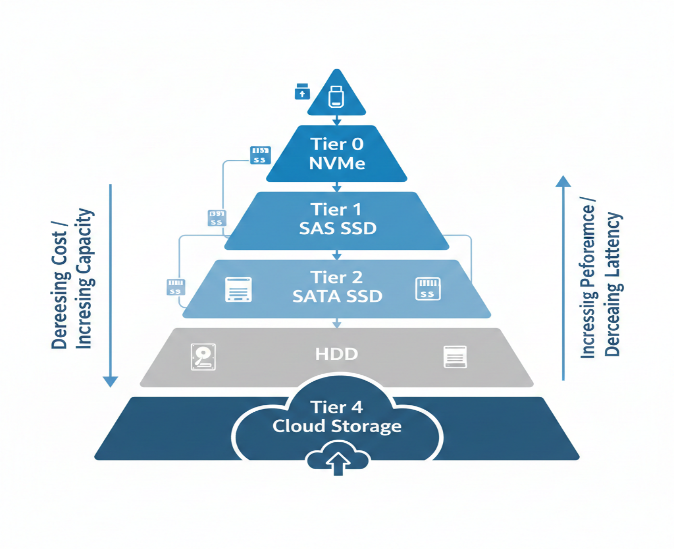
Matching workload characteristics to appropriate storage tiers ensures performance is preserved where it matters most. Not every application needs PCIe Gen5 NVMe speeds.
Architecture decisions should be data-driven, not trend-driven.
4.3 Specification Optimization
Over-specification is one of the most common cost drivers in enterprise SSD procurement.
Enterprises frequently purchase higher DWPD drives than their workloads require. For example, selecting 3 DWPD enterprise SSDs when actual workload demand is below 1 DWPD. That gap represents an avoidable cost.
Important specification review areas include:
- Right-sizing DWPD (Drive Writes Per Day)
- Evaluating latency requirements realistically
- Balancing capacity expansion vs performance need
- Avoiding excessive headroom allocation
Specification alignment reduces unnecessary premium pricing exposure.
4.4 Procurement & Supply Planning
Procurement strategy plays a major role in cost control during volatile markets. Reactive buying often leads to higher spot-market pricing.
Enterprises should:
- Engage with vendors early in fiscal planning cycles
- Qualify multiple enterprise SSD brands for compatibility
- Secure forecast-based agreements when possible
- Validate firmware and hardware compatibility in advance
Multi-vendor qualification reduces dependency risk. Refurbished Enterprise Servers & Storage also increases negotiation leverage.
Storage procurement should be proactive, not emergency-driven.
4.5 Budget Stabilization Approach
In 2026, treating storage cost as fixed is risky. Instead, enterprises should introduce financial flexibility into infrastructure planning.
Best practices include:
- Building contingency buffers into storage budgets
- Reviewing price assumptions quarterly
- Aligning SSD purchases with server refresh cycles
- Phased procurement instead of single large bulk purchases
This flexible planning reduces shock impact from sudden price increases.
4.6 Mistakes Enterprises Must Avoid
While planning strategically, certain behaviours should be avoided:
- Panic bulk buying without workload analysis
- Deploying consumer SSDs in enterprise servers
- Ignoring endurance and firmware stability factors
- Delaying upgrades until failure forces emergency procurement
- Designing storage architecture around a single vendor dependency
Each of these decisions may look practical short term but create long-term operational risk.
Long-Term Storage Planning for 2026 and Beyond
Price volatility in the Server SSD market is unlikely to disappear quickly. Enterprises must shift from reactive purchasing to long-term planning.
Develop a 3–5 Year Infrastructure Roadmap
Storage planning should align with compute refresh cycles, virtualization strategy, and projected workload growth. Without a roadmap, procurement becomes unpredictable.
Plan for AI-Driven Growth
Even organizations not directly building AI models are experiencing AI-driven analytics expansion. These workloads require higher throughput and lower latency storage layers.
Capacity and performance planning must account for this growth trend.
PCIe Generation Transition Awareness
PCIe Gen4 to Gen5 transitions impact SSD pricing tiers and server compatibility. Enterprises should verify server platform support before committing to large NVMe investments.
Technology alignment prevents premature obsolescence.
Continuous Monitoring Practices
Long-term optimization depends on continuous monitoring of:
- IOPS trends
- Latency metrics
- Endurance utilization
- Capacity growth patterns
Data-driven decisions reduce both under-provisioning and overspending.
Working with the Right Storage Partner
In volatile markets, supplier selection becomes strategic rather than transactional. A capable storage partner should provide more than just pricing sheets and product catalogs. They should understand enterprise infrastructure realities, budget constraints, and performance expectations.
Look for partners who offer:
- Access to enterprise-grade Server SSD inventory
- Multi-brand sourcing capability
- Assistance with specification alignment
- Transparent communication on lead times
- Infrastructure-focused technical consultation
The difference between a vendor and a real partner becomes very clear during pricing instability. A strong partner helps you analyse workload requirements before recommending SSD models, instead of simply pushing available stock.
Zaco Computers focus on infrastructure-aligned guidance rather than generic quotations. The approach should always start with understanding your architecture first, then recommending the right enterprise SSD solution that fits performance and budget goals.
Avoid generic promotional promises. Focus on technical clarity and realistic guidance.
A reliable partner helps you design smarter infrastructure, not just sell hardware.
Conclusion
Server SSD pricing pressure in 2026 is driven by structural market forces including controlled NAND production, expanding AI infrastructure demand, and hyperscaler purchasing behavior. These factors are unlikely to normalize quickly, which means enterprises must adapt their storage planning strategies.
Instead of reacting to price volatility with short-term cost cutting, organizations should focus on structured infrastructure planning. Conducting storage audits, optimizing SSD specifications, implementing tiered architectures, and adopting disciplined procurement strategies can significantly reduce cost exposure without sacrificing performance.
For enterprise infrastructure teams, the key takeaway is simple: performance protection and cost control must be planned together. Storage decisions should always be based on workload requirements, long-term capacity planning, and platform compatibility.
Organizations that approach SSD strategy proactively will maintain infrastructure stability, while those relying on reactive purchasing may face higher costs and operational risk.
Working with experienced infrastructure partners such as Zaco Computers can further support better planning, specification alignment, and reliable enterprise SSD sourcing in volatile market conditions.
FAQs
1. Why are Server SSD prices rising in 2026?
Server SSD prices are increasing due to controlled NAND production, strong AI infrastructure demand, and hyperscalers securing bulk inventory early. Manufacturers are also prioritizing high-margin enterprise NVMe models, which tightens supply for regular enterprise buyers.
2. Should enterprises delay upgrades because of pricing pressure?
Delaying critical storage upgrades can create performance bottlenecks and increase the risk of downtime. Instead of postponing, enterprises should optimize specifications and adopt smarter procurement strategies to manage costs effectively.
3. Is NVMe always required for enterprise workloads?
No, NVMe is not mandatory for every workload. While it delivers ultra-low latency for mission-critical applications, many enterprise systems run efficiently on SAS SSDs when properly architected.
4. How does AI demand impact enterprise SSD availability?
AI training clusters require massive volumes of high-performance NVMe SSDs, which reduces available supply in the broader market. This demand concentration leads to longer lead times and increased pricing for traditional enterprises.
5. What does DWPD mean?
DWPD stands for Drive Writes Per Day, which indicates how many times the full drive capacity can be written daily during the warranty period. It helps enterprises select the right endurance class based on actual workload write intensity.
6. Can tiered storage reduce exposure to rising SSD prices?
Yes, tiered storage allows organizations to allocate high-performance NVMe only where truly needed. By distributing workloads across NVMe, SAS, SATA, or HDD tiers, enterprises avoid overspending on premium flash everywhere.
7. Is bulk purchasing recommended during volatile pricing periods?
Bulk purchasing can work only if backed by accurate workload forecasting and financial planning. Panic buying without proper analysis may lock capital unnecessarily and increase inventory risk.
8. Are consumer SSDs suitable for enterprise servers?
Consumer SSDs lack enterprise-grade firmware stability, power-loss protection, and consistent endurance ratings. Using them in production servers can increase failure risk and compromise SLA commitments.
9. How frequently should storage utilization be reviewed?
Storage utilization should ideally be reviewed quarterly in dynamic enterprise environments. Regular monitoring helps identify underused capacity and prevents unnecessary new SSD procurement.
10. What procurement strategy works best in volatile markets?
A multi-vendor qualification approach combined with phased procurement reduces dependency risk. Early engagement with suppliers and forecast-based agreements can stabilize pricing and improve availability.
11. Is current SSD price volatility temporary?
Current market signals indicate structural shifts driven by AI expansion and disciplined NAND production. While minor fluctuations may occur, pricing pressure is unlikely to fully normalize in the near term.
12. How can enterprises protect performance while reducing cost?
Enterprises can balance cost and performance through specification optimization, proper tiered storage architecture, and continuous workload analysis. Strategic planning ensures performance integrity without unnecessary overspending.
Build a Strong SSD Strategy for 2026
If your organization is planning 2026 infrastructure upgrades, now is the right time to reassess your Server SSD strategy.
Request an enterprise SSD consultation.
Discuss your 2026 storage roadmap.
Contact Zaco Computers for structured storage planning and procurement guidance.
Plan smart. Protect performance. Control cost with strategy, not reactions.
No comments yet.