

Enterprise virtualization environments have become the backbone of modern IT infrastructure. Organizations depend on VMware platforms like vSphere, ESXi, vCenter, and Horizon to run mission-critical applications, manage workloads, and maintain operational continuity across data centers and cloud environments. Because virtualization platforms are so central to IT operations, VMware support services play an essential role in maintaining stability, security, and performance. When issues occur within a VMware environment—such as hypervisor failures, cluster performance issues, licensing problems, or configuration errors - organizations rely on expert VMware support teams to diagnose and resolve the problem quickly.
In 2026, enterprises are increasingly reassessing their VMware support strategies. Several industry changes have contributed to this shift:
- The transition toward subscription-based VMware licensing
- Changes introduced after the Broadcom acquisition of VMware
- Rising enterprise software support costs
- Increasing complexity of virtualization environments
Because of these changes, many organizations are evaluating whether OEM VMware support or third-party VMware support is the best option for managing their virtualization environments.
What Is OEM VMware Support?
Definition and Structure
OEM VMware support refers to support services delivered directly by VMware or through officially authorized VMware support programs. These services focus on the VMware software stack, including:
- vSphere
- ESXi hypervisor
- vCenter Server
- Horizon virtualization platform
- NSX networking virtualization
OEM support ensures access to VMware’s official engineering teams, updates, and software patches.
These services typically include:
- Software troubleshooting
- Version compatibility support
- Knowledge base access
- Incident response through VMware’s support portal
How OEM Support Contracts Work
OEM support contracts are typically purchased alongside VMware licenses and renewed annually as part of a subscription model. Organizations receive defined service level agreements (SLAs) based on the severity of issues reported.
Common features include:
- 24/7 ticket-based support
- Software patch updates
- Access to VMware documentation
- Escalation to VMware engineering teams
However, OEM contracts are usually standardized, meaning customization is limited. Organizations must operate within VMware’s support policies, licensing rules, and upgrade timelines.
Scope of Services and Limitations
OEM support is great for new systems, but there are some drawbacks:
- Vendor lock-in: You’re tied to the OEM ecosystem. Switching vendors is expensive.
- Short lifecycle coverage: Once VMware software versions reach end of support, organizations may be required to upgrade to maintain official vendor coverage.
- Cost escalation: Renewal fees often increase year over year.
In short, OEM support offers reliability but at a price - sometimes literally. It’s perfect if you’re starting fresh, but less ideal if you want flexibility or cost control over older systems.
What Is Third Party VMware Support?
Third-party VMware support is delivered by independent VMware specialists who provide technical assistance, troubleshooting, advisory services, and lifecycle guidance for VMware environments.
Instead of relying solely on OEM channels, enterprises work with experienced virtualization experts who can support their VMware platforms across multiple versions and deployment scenarios.
These services typically focus on:
- vSphere administration and optimization
- ESXi troubleshooting
- vCenter configuration management
- VMware Horizon environment support
- VMware upgrade planning
- VMware licensing advisory
Third-party VMware support providers often deliver highly personalized VMware support services tailored to enterprise environments.
VMware Platform Coverage
A key advantage of third-party support is deep technical expertise across multiple VMware platforms.
Support teams frequently assist with:
vSphere Support
Helping organizations manage clusters, virtual machines, and distributed resource scheduling.
ESXi Hypervisor Support
Troubleshooting hypervisor errors, host connectivity problems, and performance bottlenecks.
vCenter Server Support
Resolving issues related to cluster management, host configuration, and virtual infrastructure orchestration.
VMware Horizon Support
Supporting virtual desktop environments and troubleshooting VDI deployment challenges.
These services ensure that VMware environments remain stable, secure, and efficient.
Key Differences Between Third Party VMware Support and OEM Support
Let’s break it down more clearly. Here’s a detailed comparison:
| Feature | OEM VMware Support | Third-Party VMware Support |
|
Support Source |
VMware official channels |
Independent VMware specialists |
|
Licensing Advisory |
Limited guidance |
Often more strategic advisory |
|
Support Flexibility |
Standardized contracts |
Custom support models |
|
VMware Version Coverage |
Typically latest versions |
Support for multiple versions |
|
Cost Structure |
Subscription-based |
Often more flexible |
While both models provide software troubleshooting, the primary difference lies in support flexibility and advisory services.
Risk Considerations in 2026
Selecting the right VMware support model requires careful evaluation of operational risks.
Operational Dependency
Relying exclusively on one vendor for support can limit flexibility, particularly when licensing structures change.
Licensing Complexity
VMware licensing has become more complex, especially after recent industry developments. Organizations need clear guidance to avoid unexpected costs.
Environment Stability
Virtualization platforms support critical applications, so organizations must ensure their VMware support provider has strong expertise in diagnosing and resolving issues quickly.
Impact of Broadcom’s VMware Changes
One of the biggest shifts in the VMware ecosystem came after the acquisition of VMware by Broadcom.
Several changes have influenced how enterprises approach VMware support:
Subscription Licensing
VMware licensing is increasingly moving toward subscription-based models, reducing the availability of perpetual licenses.
Contract Consolidation
Many enterprise contracts are being restructured, affecting how organizations manage long-term support agreements.
Increased Cost Pressure
Some organizations have reported higher licensing and support costs under the new model, prompting a revaluations of support strategies.
Because of these developments, enterprises are exploring new ways to manage VMware environments efficiently while maintaining budget control.
5-Year Cost Comparison Model (OEM vs Third Party)
Let’s visualize cost differences over a five-year period.
Cost Escalation under OEM
- Year 1: OEM VMware support may appear cost-effective initially.
- Year 2 - 5: Renewal costs often increase over time due to subscription pricing adjustments, licensing changes, and evolving vendor policies. Many organizations report annual increases in the range of 10–15%, which can significantly raise long-term support expenditure.
Third Party Flat Pricing
- Year 1 - 5: Pricing is predictable.
- You avoid forced upgrades.
- Total cost over five years can be up to 50% lower depending on the environment, infrastructure size, and existing support contracts.
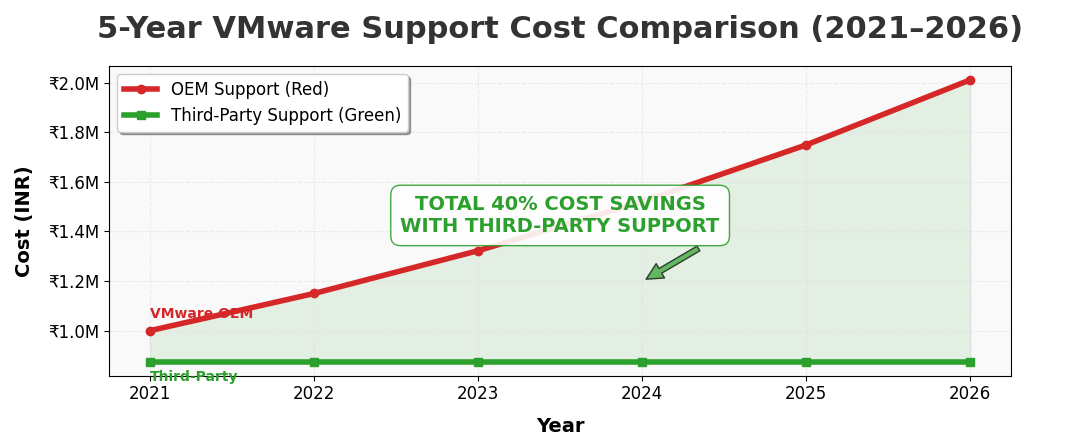
Source: Enterprise infrastructure cost benchmarks (2021–2026).
This graph shows a 5-year VMware support cost comparison (2021–2026) between OEM support (red line) and third-party support (green line).
- The red line rises steadily, showing that OEM support costs increase each year, reflecting typical annual renewal escalations.
- The green line remains flat, indicating that third-party support costs stay stable over the same period.
- The highlighted section emphasizes that using third-party support can lead to up to 40% total cost savings by 2026 compared to OEM support.
For organizations running older VMware versions, third-party support can provide a more cost-effective alternative.
When OEM Support Is the Right Choice
OEM support isn’t bad - it has a clear place. Consider it if:
• The environment is running the latest VMware software versions and requires direct access to VMware engineering teams.
• IT operations follow VMware’s official upgrade roadmap and licensing policies.
• Vendor-backed support with standardized service level agreements is a priority.
OEM support provides direct access to VMware updates, patches, and official support channels. For organizations that prioritize vendor-certified support and are comfortable with subscription-based pricing models, OEM support can offer reassurance and predictable service structures.
When Third Party VMware Support Is the Better Strategic Choice
VMware Third-party support is the strategic choice for the long haul:
- Your VMware environment is stable and running existing software versions that continue to meet operational requirements.
- You want to reduce costs and avoid forced upgrades.
- You need extended lifecycle coverage, beyond what OEM can provide.
- You operate a mixed-vendor environment where flexibility is key.
In 2026, especially with Broadcom changes, third-party VMware support isn’t just cheaper - it allows enterprises to control lifecycle, performance, and costs in a way OEM cannot match.
Hybrid Support Strategy in 2026
Many enterprises are now adopting a hybrid VMware support model, combining the best of both worlds:
- OEM support for environments that require direct vendor access to VMware updates, patches, and official engineering resources.
- Third-party VMware support for stable or legacy VMware versions, helping organizations maintain existing environments without immediate upgrade pressure.
- Budget optimization, balancing investment between OEM and third-party support based on operational priorities and risk tolerance.
- Risk diversification, reducing dependency on a single vendor while maintaining strong SLA coverage.
- Strategic roadmap planning, aligning VMware support decisions with long-term virtualization and licensing strategies.
This approach ensures your VMware environment remains flexible, resilient, and cost-effective, adapting as business priorities evolve.
Strategic VMware Support Advisory from Zaco Computers
At Zaco Computers, we help enterprises make informed VMware support decisions:
- Infrastructure cost assessment: We evaluate current support contracts, and TCO to identify inefficiencies.
- VMware environment evaluation: Detailed assessment of clusters, performance bottlenecks, and software compatibility.
- Cost planning consultation: Model OEM vs third-party pricing scenarios, ROI, and lifecycle projections.
- Practical support transition roadmap: Step-by-step guidance for moving from OEM to third-party or hybrid models seamlessly.
Our goal is simple: maximize performance, reduce costs, and give enterprises control over VMware support.
Conclusion
Choosing between OEM and third-party VMware support in 2026 is not just about cost. It’s about flexibility, lifecycle management, risk reduction, and operational excellence.
Here’s the final take:
- OEM support is ideal for environments running the latest VMware software versions and organizations that prefer fully vendor-certified support models. It’s reliable but can be costly over time.
- Third-party support is the strategic long-term option, especially for organizations running stable VMware environments. It helps maintain existing VMware platforms, reduce costs, and improve operational flexibility.
- Hybrid support often delivers the best balance: OEM for new, critical systems, and third-party for legacy or multi-vendor clusters.
The key for 2026: align your support strategy with your business goals, technology roadmap, and budget, ensuring you are not trapped by escalating costs or vendor restrictions.
Enterprises that proactively plan VMware support today are better positioned to save money, reduce risks, and maintain high performance across their entire infrastructure.
Frequently Asked Questions
1. How does Broadcom’s acquisition of VMware impact support?
Broadcom has shifted VMware to a subscription-based model, reducing perpetual licensing. This affects pricing, contract renewals, and may increase costs for mid-sized businesses looking to maintain OEM support.
2. Is third-party VMware support cheaper than OEM?
Yes, typically. Third-party support often offers flat or controlled pricing over multiple years, while OEM contracts escalate annually, which can lead to significantly higher TCO over time.
3. What is a hybrid VMware support model?
A hybrid model combines OEM support for new, mission-critical systems with third-party support for older or legacy environments. This balances cost, risk, and operational flexibility.
4. Will OEM support cover multi-vendor environments?
No. OEM support is generally limited to the vendor’s certified software. For mixed-vendor clusters, third-party support provides better coverage and flexibility.
5. How often do OEM support renewals increase?
OEM VMware support renewals often increase over time due to licensing adjustments and vendor pricing structures. Industry reports suggest annual increases commonly range between 10–15% depending on contract structure and licensing model.
Source: Gartner IT Infrastructure Cost Optimization Research, Broadcom VMware licensing transition reports.
6. Is SLA different between OEM and third-party support?
OEM SLAs are typically fixed and tied to vendor-certified software. In contrast, third-party support providers can offer more flexible and customizable SLAs across mixed IT environments, often delivering faster response times for critical issues.
7. When should an enterprise choose OEM support?
OEM support is ideal for brand-new deployments, high-dependency vendor ecosystems, and short-term lifecycle strategies where vendor certification matters most.
8. How do third-party support providers handle legacy systems?
They use multi-vendor expertise to maintain, troubleshoot, and optimize legacy VMware environments and clusters, ensuring continued performance without forced upgrades.
9. Can mid-sized businesses benefit from third-party support?
Definitely. Third-party support offers predictable pricing, lifecycle extension, and operational flexibility - making it ideal for mid-sized enterprises with budget constraints.
9. Does a hybrid model reduce operational risk?
Yes. By splitting support between OEM and third-party, enterprises minimize vendor dependency, reduce cost escalation, and ensure critical systems are fully supported.
Optimize Your VMware Support Strategy Today
Don’t wait for rising costs or sudden EOL issues to impact your business. At Zaco Computers, we help enterprises like yours evaluate VMware support, optimize costs, and extend infrastructure lifecycles.
Whether you need OEM, third-party, or a hybrid model, our strategic advisory services give you a clear roadmap to:
- Reduce support costs
- Maintain high SLA performance
- Align IT support with business goals
Visit https://www.zacocomputer.com/ today to schedule a custom VMware support consultation. Take control of your infrastructure, maximize ROI, and future-proof your VMware environment in 2026 and beyond.