

2026 is not a normal year for IT departments. Everyone wants more performance, more uptime, more security. But when it comes to budget approval… things suddenly become quiet.
Enterprise hardware pricing has gone up. Component costs are rising. Large-scale AI data center deployments are increasing demand for semiconductor chips, which can indirectly affect availability and pricing for enterprise hardware. Even mid-range enterprise servers now require serious capital planning.
If you are an IT decision-maker, you probably asked yourself this already:
“Do we really need brand-new servers every time?”
This is where refurbished HPE and Dell servers are becoming a strategic choice instead of just a cost-saving alternative. Businesses are not buying refurbished servers because they have no option. They are buying because it makes financial and operational sense.
Enterprise Hardware Cost Trends in 2026
The global enterprise hardware market is shifting. Large-scale AI deployments and cloud data center expansions are driving processor and memory demand to record levels. This indirectly impacts enterprise buyers who simply need stable infrastructure.
Why New Server Costs Are Increasing
- Rising semiconductor manufacturing costs
- High enterprise SSD pricing
- Supply-demand imbalance in CPUs
- OEM premium margins
- Increased logistics and operational expenses
For SMEs and mid-sized enterprises, this means higher CapEx pressure. Instead of allocating budget to innovation or cybersecurity upgrades, a large portion goes into hardware refresh cycles.
That’s not always efficient. Businesses are now evaluating total cost of ownership instead of just performance metrics.
What Refurbished Servers Actually Mean (Not Just “Used”)
There is still a misunderstanding in the market. Refurbished does NOT mean random second-hand hardware sold without testing.
Professionally refurbished enterprise servers go through:
- Complete hardware diagnostics
- Component-level inspection
- Replacement of faulty parts
- Firmware and BIOS updates
- Stress testing under load
- Cleaning and re-certification
That process ensures operational reliability.
The difference between “used” and “certified refurbished” is massive. One is uncertain. The other is structured and validated. And when sourced from experienced suppliers, refurbished HPE and Dell servers perform like stable enterprise machines again.
Extending Server Life Beyond EOL and EOSL
When OEMs declare End of Life (EOL) or End of Service Life (EOSL), many companies feel forced to upgrade immediately.
But here Enterprise hardware from brands like Hewlett Packard Enterprise and Dell Technologies is built for durability. Hardware does not suddenly fail because a date changed on a support document.
The Real Impact of Forced Refresh Cycles
- High capital expenditure
- Underutilized hardware replacement
- Increased depreciation
- Infrastructure inconsistency
Refurbished servers allow organizations to extend infrastructure lifecycle strategically. Instead of replacing entire environments, companies can upgrade components, expand memory, or integrate third-party support.
This protects ROI and avoids unnecessary spending. Sometimes the smartest move is not replacing. It is optimizing.
Why Refurbished HPE Servers Make Financial Sense
HPE enterprise servers are known for their stability in virtualization, ERP, and database environments. Even after several years of operation, many systems remain technically strong and workload capable.
Refurbished HPE servers offer:
- High memory scalability
- Multi-processor configurations
- RAID storage flexibility
- Virtualization readiness
- Reliable performance for production workloads
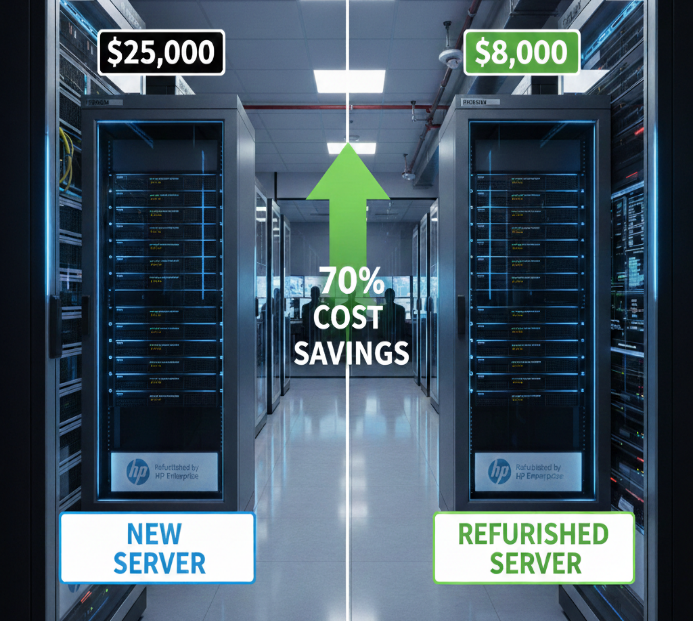
Financially, the cost difference between new and refurbished HPE deployments can range between 40% and 70%.
That is not a small number. For many businesses, that savings means funding other critical IT projects without increasing total budget allocation.
Why Refurbished Dell Servers Offer Strong ROI
Dell enterprise servers are popular because of their balanced performance architecture. They integrate smoothly into hybrid IT environments and support modern business workloads effectively.
Refurbished Dell servers provide strong performance-to-price ratio. They can be customized based on workload requirements without overspending.
They are ideal for:
- Infrastructure scaling
- Expansion nodes
- Backup environments
- Development labs
- Cost-controlled production systems
Instead of committing large CapEx to new hardware, companies can scale gradually and intelligently.
And that flexibility in 2026? It is very valuable.
New vs Refurbished Servers - Budget Impact Comparison
Here is a simple comparison for decision clarity:
| Factor | New Servers | Refurbished Servers |
|
Initial Cost |
High |
Significantly Lower |
|
Depreciation |
Rapid (3–5 years) |
Lower financial impact |
|
ROI Timeline |
Longer recovery |
Faster recovery |
|
Budget Flexibility |
Limited |
High |
|
Ideal For |
High-budget refresh |
Strategic cost optimization |
|
Custom Configuration |
Customization available but often increases price significantly |
Highly flexible configuration with lower cost impact for RAM, storage, and CPU upgrades |
This comparison shows that refurbished infrastructure improves capital efficiency without sacrificing operational goals.
Cost Comparison Over 5 Years
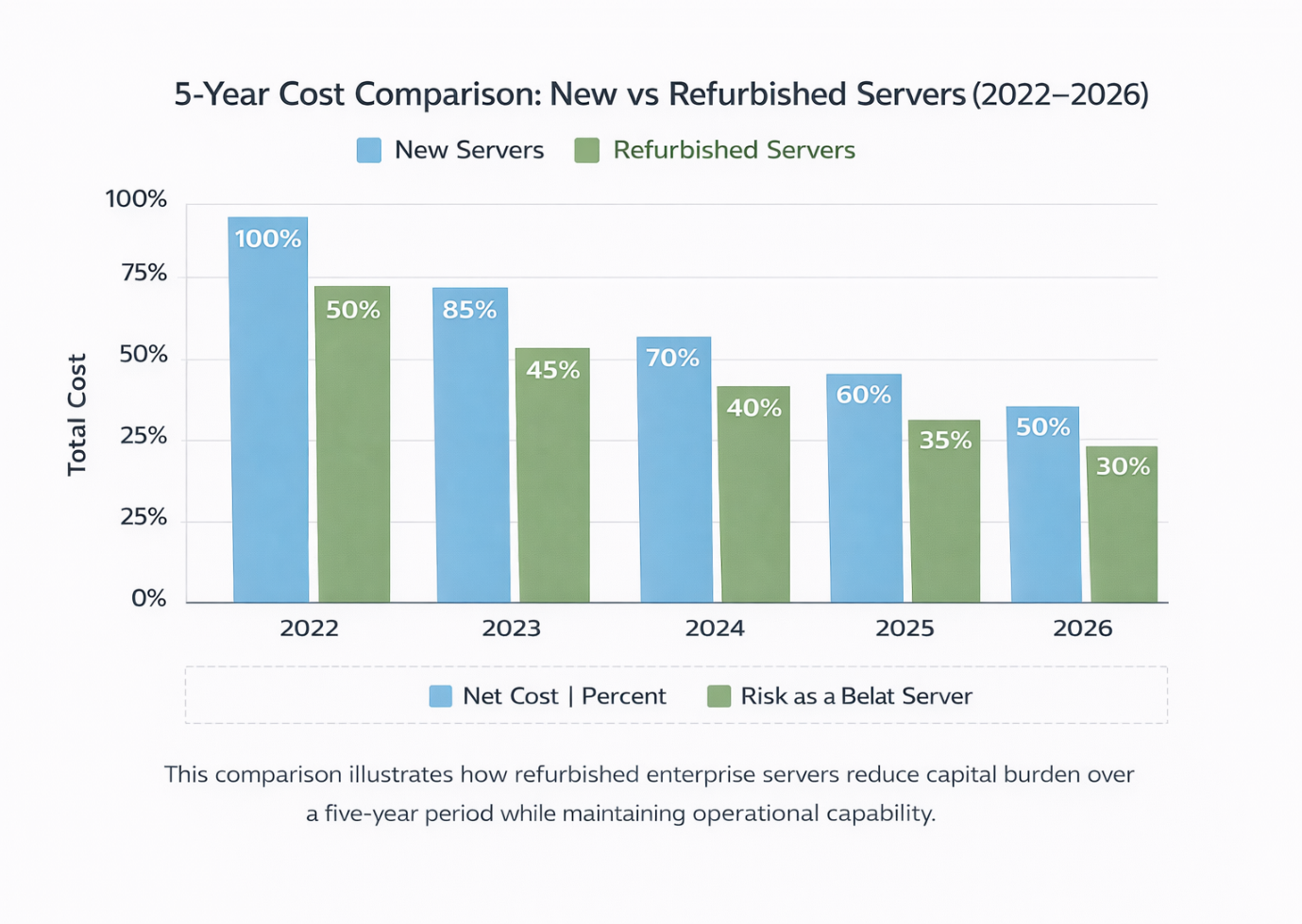
Source: Industry pricing trends compiled from enterprise hardware lifecycle studies and refurbished server market benchmarks (2022–2026).
This graph compares the total capital cost percentage of New Servers vs Refurbished Servers over five years - from 2022 to 2026. The purpose is to visually show how cost burden changes over time and why refurbished infrastructure becomes financially strategic.
Year-by-Year Breakdown
2022
- New Servers: 100% (Baseline year – highest capital investment)
- Refurbished Servers: 50%
In 2022, new servers represent full capital expenditure. Refurbished options already show nearly 50% cost savings at the starting point.
2023
- New Servers: 85%
- Refurbished Servers: 45%
Costs begin stabilizing, but refurbished hardware continues to maintain a clear advantage. The savings gap remains wide, making refurbished ideal for expansion or scaling projects.
2024
- New Servers: 70%
- Refurbished Servers: 40%
By mid-cycle, enterprises replacing or adding infrastructure see significant CapEx differences. Refurbished servers deliver similar operational performance at almost 30% lower relative cost compared to new.
2025
- New Servers: 60%
- Refurbished Servers: 35%
Hardware depreciation affects both categories, but refurbished infrastructure continues to reduce financial strain. This year typically reflects upgrade planning or hybrid deployments.
2026
- New Servers: 50%
- Refurbished Servers: 30%
At the end of the five-year window, total ownership cost clearly favours refurbished systems. Organizations that chose refurbished early experience a lower cumulative capital burden across the lifecycle.
Performance Without Compromise
A very common question is simple:
“Will refurbished servers handle our workloads properly?”
Performance depends on configuration, not manufacturing date alone. Enterprise servers are designed with redundancy systems like dual power supplies, RAID controllers, ECC memory, and advanced cooling architecture. When refurbished properly, these features remain intact.
Refurbished HPE and Dell servers successfully support:
- Virtualization platforms
- ERP systems
- SQL databases
- Backup & disaster recovery
- Development environments
In many real-world deployments, organizations successfully run production workloads on refurbished servers with performance levels that meet their operational requirements. Performance is about planning. Not packaging.
Who Should Consider Refurbished HPE & Dell Servers
Refurbished servers are not for every scenario. But they are perfect for many business models.
Ideal for:
- Small and mid-sized enterprises
- Growing companies expanding infrastructure
- Data center expansion projects
- Backup and disaster recovery environments
- Development & testing labs
- Organizations managing EOL/EOSL systems
If your business fits into these categories, refurbished is not risky. It is logical budgeting.
Why Businesses Source Refurbished HPE & Dell Servers from Zaco Computers
Vendor selection is critical in refurbished hardware.
Zaco Computers focuses on:
- Professionally tested enterprise-grade systems
- Transparent configuration details
- Competitive pricing aligned with IT budgets
- Warranty-backed hardware
- Ready inventory for quick deployment
- Experience handling enterprise server environments
In infrastructure planning, trust and testing standards matter more than marketing claims. When you combine cost efficiency with structured quality control, refurbished becomes a powerful strategy.
Strategic IT Budgeting in 2026
2026 is not about cutting corners. It is about cutting unnecessary expenses.
Refurbished HPE and Dell servers allow businesses to:
- Extend infrastructure lifecycle
- Protect capital allocation
- Improve ROI
- Maintain stable performance
- Scale without financial stress
Sometimes the best IT decisions are not about buying the newest thing in the market. They are about buying what your workload truly needs. And in many cases, refurbished servers deliver exactly that.
Frequently Asked Questions
1. Are refurbished HPE and Dell servers reliable for enterprise workloads?
Yes, professionally refurbished servers go through structured hardware testing, stress validation, and component checks before resale. When sourced from a trusted supplier, they deliver stable enterprise-level reliability for production environments.
2. Do refurbished servers come with warranty coverage?
Yes, certified refurbished server providers typically offer warranty-backed systems with defined coverage terms. At Zaco Computers, refurbished HPE and Dell servers come with a standard 1-year hardware warranty, with extended warranty options available for organizations that require longer infrastructure protection. This ensures hardware reliability and operational confidence for IT teams deploying refurbished systems.
3. Can refurbished servers handle virtualization platforms like VMware?
Yes, refurbished HPE and Dell servers support virtualization when configured with adequate CPU cores and RAM. Many businesses successfully run VMware, Hyper-V, and Proxmox environments on refurbished infrastructure.
4. What does EOL or EOSL mean for server hardware?
EOL and EOSL indicate the end of OEM support, not hardware failure. Servers often continue operating efficiently for years with proper maintenance and third-party support.
5. Is performance significantly lower compared to new servers?
In real-world enterprise workloads, performance difference is usually minimal if hardware is properly configured. Resource planning and workload alignment matter more than the “new” label.
6. How much cost savings can businesses expect?
Companies typically save up-to 40% to 70% compared to new enterprise server purchases. The exact savings depend on configuration, generation, and hardware specifications.
7. Are refurbished servers suitable for production environments?
Yes, many organizations deploy refurbished servers in live production setups. Stability depends on testing quality and correct workload distribution.
8. Can refurbished servers be customized according to business needs?
Yes, RAM, storage drives, RAID controllers, and processors can be configured as per workload demands. This flexibility allows businesses to optimize performance without overspending.
9. Do refurbished servers support SSD and high-speed storage?
Most enterprise models support SSD, SAS, and NVMe configurations depending on generation. Storage upgrades are commonly done during refurbishment.
10. Is refurbished hardware a long-term infrastructure strategy?
Yes, many enterprises adopt a hybrid infrastructure model using both new and refurbished servers. This approach balances cost control with performance scalability.
11. How fast is delivery compared to new server orders?
Refurbished servers are often available in ready inventory, reducing procurement time significantly. This helps businesses deploy infrastructure faster.
12. Which industries benefit the most from refurbished servers?
SMEs, educational institutions, IT service providers, start-ups, and data center operators benefit greatly. Any organization optimizing CapEx can leverage refurbished solutions effectively.
Build Smarter IT Infrastructure in 2026
Organizations evaluating it infrastructure upgrades in 2026 should consider solutions that balance performance, reliability, and capital efficiency. Refurbished enterprise servers can provide a practical path for expanding IT capacity without committing to unnecessary hardware spending.
Explore refurbished HPE and Dell servers at Zaco Computers to evaluate configurations that align with your infrastructure goals and budget planning strategy.
No comments yet.