

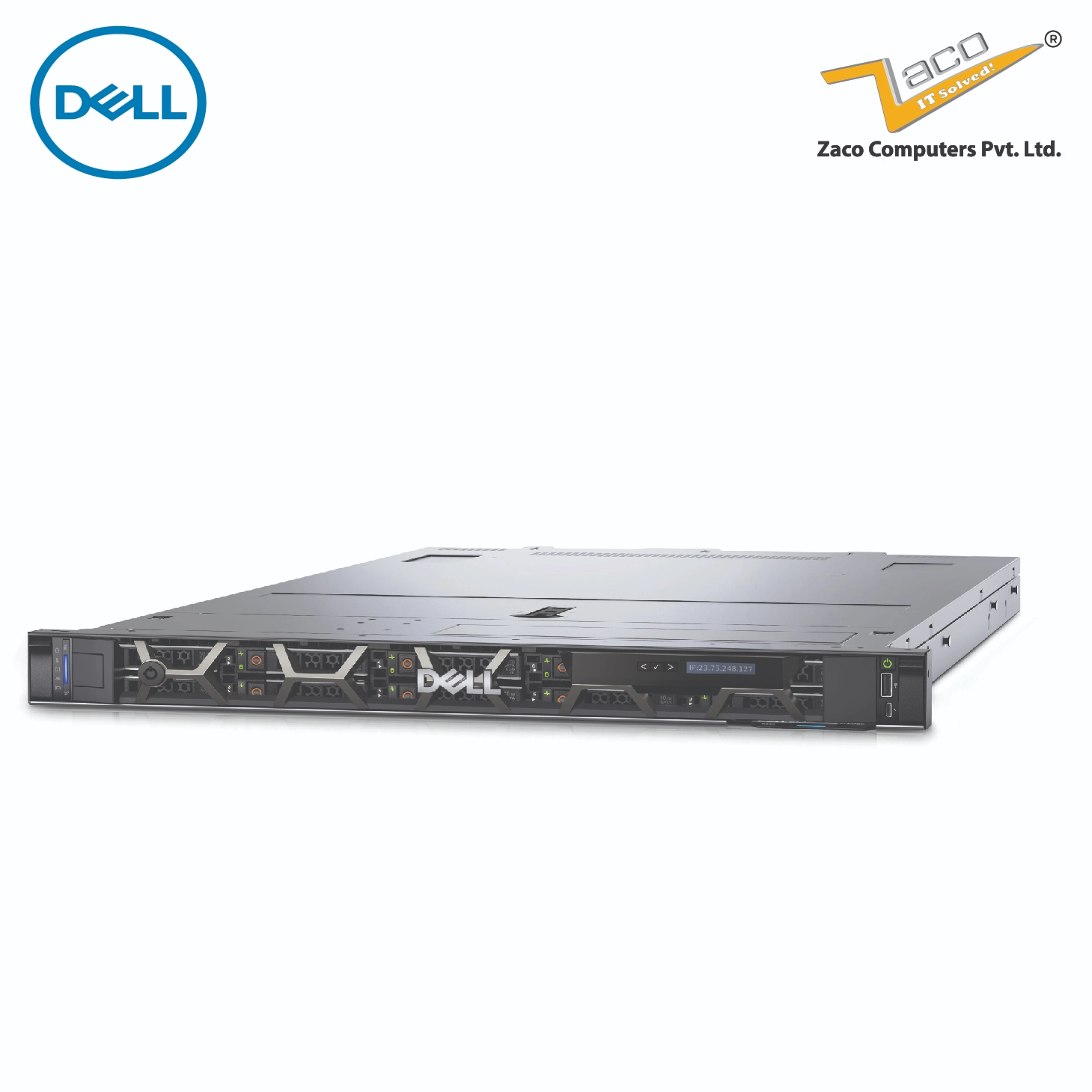
Dell PowerEdge R650 Server
| Brand: | DELL |
| Model / Part Number: | PowerEdge R650 Server |
| Form Factor: | 1U Rack |
| Processor: | Up to two 3rd Generation Intel Xeon Scalable processors, with up to 40 cores per processor |
| Memory: | 32 DDR4 DIMM slots, supports RDIMM 2 TB max or LRDIMM 8 TB max, speeds up to 3200 MT/s |
| Storage Hard Disk Drive: | Front Bays: Up to 10 x 2.5-inch SAS/SATA/NVMe (HDD/SSD) max 153 TB; Rear Bays: Up to 2 x 2.5-inch SAS/SATA/NVMe (HDD/SSD) max 30.7 TB |
| Raid Controller: | Internal controllers: PERC H745, HBA355I, S150, H355, H345, H755, H755N; External PERC (RAID): PERC H840, HBA355E |
| Power Supply: | 800W, 1100W, 1400W Platinum AC/240 Mixed Mode |
Available in store
Description
Dell PowerEdge R650 Server: The Enterprise Standard for Performance and Density
In the rapidly evolving landscape of data center technology, the Dell PowerEdge R650 Server stands as a premier solution designed to optimize performance without sacrificing floor space. As a dual-socket 1U platform, this system provides the ideal balance between processing power, high-speed memory, and versatile storage configurations. Whether your organization is managing massive virtualization clusters or intensive database applications, the Dell PowerEdge R650 Server offers the scalability required to meet modern enterprise demands.
Technical Overview of the R650 Server
The Dell PowerEdge R650 Server is engineered to leverage the full potential of 3rd Generation Intel Xeon Scalable processors. By integrating advanced PCIe Gen4 capabilities, this R650 Server doubles the throughput compared to previous generations, ensuring that data bottlenecks are a thing of the past. Its 1U chassis is a masterpiece of thermal engineering, allowing high-wattage components to operate at peak efficiency even under sustained heavy loads.
As a high-density Dell PowerEdge R650 Rack Server, it addresses the needs of IT administrators who must maximize compute power per rack unit. The inclusion of hardware-root-of-trust security and proactive management tools makes the PowerEdge R650 Server a reliable foundation for any digital transformation journey.
Comprehensive Dell PowerEdge R650 Rack Server Specification
Choosing the right hardware requires a deep dive into the specification details. The following table highlights the core components that define the capabilities of the PowerEdge R650 Rack Server.
Performance and Processing Power
The heart of the Dell PowerEdge R650 Rack Server lies in its ability to house up to 80 total cores in a single 1U node. By utilizing the 3rd Generation Intel Xeon Scalable processors, users benefit from Intel Deep Learning Boost, which significantly accelerates AI and machine learning inference tasks. This makes the PowerEdge R650 an excellent candidate for real-time analytics and predictive modeling.
Furthermore, the transition to PCIe Gen4 slots within the PowerEdge R650 Server means that network interface cards (NICs) and NVMe storage can communicate with the CPU at twice the speed of Gen3. This reduction in latency is critical for high-frequency trading, software-defined storage (SDS), and complex scientific simulations.
Unmatched Memory and Storage Flexibility
When it comes to memory-intensive applications like SAP HANA or large-scale VDI (Virtual Desktop Infrastructure) deployments, the PowerEdge R650 excels. With 32 DDR4 DIMM slots, the system supports up to 8 TB of LRDIMM memory. This massive memory footprint ensures that even the most demanding in-memory databases run smoothly without hitting physical limits.
Storage versatility is another hallmark of the R650 Rack Server. Organizations can choose between traditional high-capacity SAS/SATA HDDs for bulk storage or ultra-fast NVMe SSDs for tier-0 applications.
- Front Storage: The 10-bay configuration allows for a mixture of drive types, reaching up to 153.6 TB of localized storage.
- Rear Storage: For boot drives or additional cache, the rear 2-bay option supports up to 30.72 TB, keeping the front bays available for primary data.
RAID Configuration Options
The Dell PowerEdge R650 Server supports a wide array of PERC (PowerEdge RAID Controller) options. For those seeking maximum performance from NVMe drives, the PERC H755N is specifically designed to handle NVMe RAID without creating a bottleneck, a common issue in older hardware architectures.
Enterprise-Grade Management and Security
Managing a fleet of hardware can be complex, but the PowerEdge R650 Server simplifies this through the Integrated Dell Remote Access Controller (iDRAC9). This tool provides a comprehensive, "agent-free" management environment, allowing IT teams to deploy, update, and monitor the R650 Server from anywhere in the world.
Key Security Features:
- Silicon Root of Trust: Ensures that only cryptographically signed firmware is loaded.
- System Lockdown: Prevents unauthorized or malicious changes to the system configuration and firmware.
- Secure Erasure: Allows for the rapid and thorough removal of data from storage media before decommissioning or repurposing the hardware.
Optimized Use Cases
The Dell PowerEdge R650 Rack Server is not a one-size-fits-all machine; it is a highly adaptable platform suitable for various enterprise roles:
- Cloud Infrastructure: Ideal for building private and hybrid clouds where density and performance are paramount.
- Virtualization: High core counts and massive RAM capacity allow for high VM density per rack unit.
- High-Performance Computing (HPC): The support for 3200 MT/s memory and Gen4 throughput makes it a workhorse for research and engineering.
- Database Analytics: Large NVMe storage arrays and high-speed processing enable lightning-fast queries and data processing.
Configuration Flexibility and OS Support
The PowerEdge R650 is designed to integrate into any existing software ecosystem. Whether your stack is built on open-source platforms or proprietary enterprise software, this server provides validated compatibility.
Supported Operating Systems:
- Microsoft Windows Server: Full support for Hyper-V and standard roles.
- VMware vSphere: Optimized for ESXi environments and vSAN deployments.
- Linux Distributions: Certified for Red Hat Enterprise Linux (RHEL), SUSE Linux Enterprise Server (SLES), and Ubuntu.
- Citrix: Ready for XenServer and application delivery workloads.
Flexible Server Rental Options
We understand that not every project requires a permanent hardware investment. We offer flexible rental plans for the Dell PowerEdge R650 Server. This is an ideal solution for short-term projects, data migration tasks, or testing new software environments before committing to a full purchase. Our rental agreements include full technical support, ensuring your uptime remains a priority.
Understanding Power Consumption and Cooling
Given its high-performance components, managing power consumption is vital for maintaining a low Total Cost of Ownership (TCO). The PowerEdge R650 features Multi-Vector Cooling 2.0, which uses advanced fans and airflow paths to direct cooling where it is needed most. With power supply options ranging from 800W to 1400W in Platinum and Titanium efficiencies, organizations can right-size their power delivery to match their specific hardware configuration, reducing energy waste and heat output.
Why Choose a Refurbished R650?
For budget-conscious organizations, a refurbished Dell PowerEdge R650 Server offers an exceptional price-to-performance ratio. Buying refurbished allows you to access enterprise-grade hardware that has been rigorously tested and certified for reliability at a fraction of the cost of new equipment. This is a sustainable and cost-effective way to scale your infrastructure without compromising on quality or the latest features of the R650 Rack Server.
Frequently Asked Questions (FAQ)
1. How many processors can be installed in a Dell PowerEdge R650 server?
The system supports up to two 3rd Generation Intel Xeon Scalable processors, allowing for a combined total of up to 80 cores and 160 threads in a single 1U chassis.
2. Can the Dell PowerEdge R650 server handle heavy workloads?
Yes, it is specifically designed for compute-intensive workloads including high-density virtualization, large-scale database management, AI/ML inference, and high-performance computing (HPC).
3. What security features are included in the Dell PowerEdge R650 server?
The server includes a Silicon Root of Trust, System Erase, Secure Boot, and System Lockdown mode via iDRAC9 to protect against firmware tampering and unauthorized access.8
4. Does Zaco Computers ensure round-the-clock technical support for its customers?
Yes, Zaco provides 24/7 technical support to ensure your infrastructure remains operational, offering expert guidance for any hardware or configuration issues.9
5. Do you offer support for server installation and initial configuration?
Absolutely. We provide end-to-end support, from the initial unboxing and physical installation in your rack to the deployment of the OS and RAID configurations.
6. How many NVMe drives can the Dell PowerEdge R650 support?
In its maximum configuration, the server can support up to 12 NVMe drives (10 in the front bays and 2 in the optional rear bays) for ultra-low latency storage performance.10
7. What is the difference between the PowerEdge R650 and the R650xs?
The R650 is the flagship high-performance model with 32 DIMM slots and maximum expansion.11 The R650xs (Specialized) is a cost-optimized version with 16 DIMM slots and is tailored for specific scale-out workloads.12
8. Which iDRAC license do I need for remote console access?
For full remote console access, virtual media support, and advanced power management, you will require an iDRAC9 Enterprise or Datacenter license.
9. Does the R650 support GPU accelerators?
Yes, the PowerEdge R650 can support up to three single-width GPUs (up to 75W each), making it suitable for VDI and light AI inference tasks.13
10. How much VRAM is needed to run a 70B parameter model on this server?
To run a 70B parameter model in 16-bit (FP16), you would need approximately 140 GB of VRAM. However, using 4-bit quantization, you can run it on roughly 40-48 GB of VRAM. Since the R650 is limited to 75W GPUs, multiple Tesla T4s or similar cards would be required.
11. Can I upgrade the server after purchase?
Yes, the modular design allows for easy upgrades to the CPU, RAM, storage drives, and RAID controllers. You can also add various OCP 3.0 or PCIe network cards as your bandwidth needs grow.
12. What are the power requirements for a high-performance R650 configuration?
High-performance builds with dual 40-core CPUs and full NVMe arrays typically require the 1100W or 1400W Platinum/Titanium power supplies to ensure redundancy and efficiency under peak load.
Experience the Power of Dell Enterprise Hardware
The Dell PowerEdge R650 Server is more than just a piece of hardware; it is a strategic asset for any business looking to lead in the digital era. With its uncompromising performance, advanced security, and industry-leading management, it ensures that your data center is ready for whatever the future holds.
Our USPs:
- Affordable Pricing: We provide competitive rates on both new and refurbished units to fit your budget.
- EOL & EOSL Support: We specialize in supporting End-of-Life and End-of-Service-Life products, ensuring your legacy systems remain operational.
- Worldwide Shipping: No matter where your data center is located, we offer reliable and fast global logistics.
Ready to upgrade your infrastructure? Contact our specialist team today for a customized quote on the Dell PowerEdge R650 Server or to discuss our flexible rental and configuration options. Let us help you build a more powerful, efficient, and secure data center.