

Every enterprise running Windows Server or SQL Server eventually faces the same situation: Microsoft's official support lifecycle ends, and the business is left with a hard choice to upgrade on Microsoft's timeline or accept the risk of running unsupported infrastructure. For many organisations, neither option is straightforward. Migrations are complex, expensive, and disruptive. And yet, continuing without any support structure is not a viable strategy for environments handling business-critical data. This is precisely where Microsoft third party support changes the equation. It provides a credible, structured alternative that keeps your existing infrastructure fully supported without forcing software refreshes.
Understanding Microsoft's Support Lifecycle and Where the Gap Appears
Microsoft's product lifecycle follows a fixed two-phase model. During Mainstream Support which covers the first five years of a product's life organisations receive the full range of updates: bug fixes, design changes, and feature improvements. In the Extended Support phase, which runs from year six to year ten, coverage narrows to security patches and paid incident support only. Once Extended Support ends, all OEM coverage stops completely.
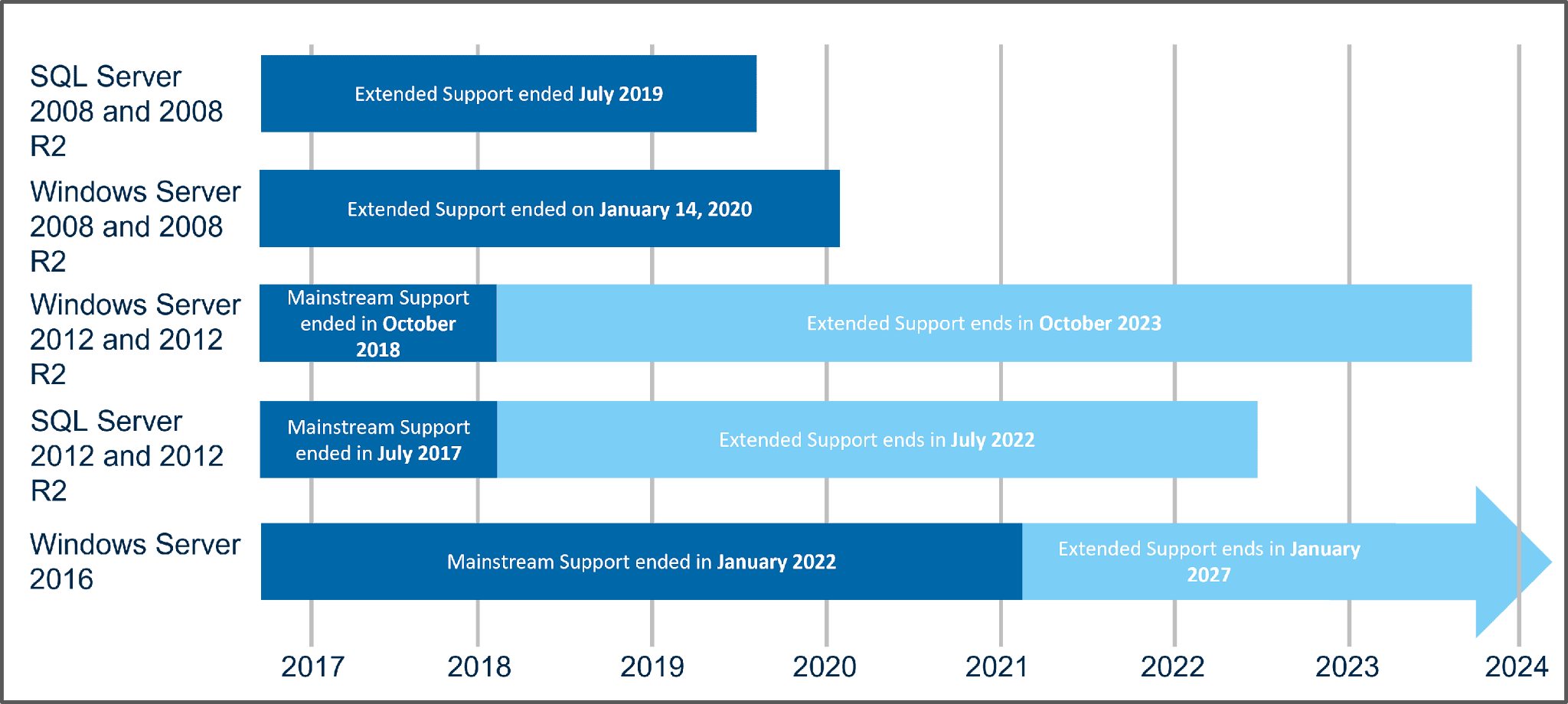 Source: Microsoft Product Lifecycle Policy
Windows Server 2012 and 2012 R2
Both versions reached full end-of-life in October 2023 meaning they have been without Microsoft support for over two years as of early 2026. Despite this, a significant number of organisations in India and globally continue to operate business-critical workloads on these platforms, primarily because the cost and complexity of migration has not yet been fully funded or resourced.
Third party support providers offer comprehensive coverage for 2012 and 2012 R2 environments all without requiring the organisations to commit to Microsoft's ESU programme.
Windows Server 2016
With Extended Support ending in January 2027, Windows Server 2016 is the most time-sensitive EOL concern for organisations in early 2026. Many enterprises are discovering that their application estate has not been fully validated for Windows Server 2022 or 2025, and that a migration cannot realistically be completed before the January 2027 deadline without unacceptable project risk.
Engaging Microsoft Third Party Support now for Windows Server 2016 environments provides a structured, cost-predictable bridge period typically 12 to 24 months during which the migration project can be properly planned, resourced, and executed without operational disruption.
Windows Server 2019 (Extended Support)
While Windows Server 2019 remains in Extended Support through January 2029, organisations managing large 2019 deployments are increasingly evaluating third party support for the final years of the lifecycle.
What Is Microsoft Third Party Support?
Microsoft third party support refers to engaging an independent provider rather than Microsoft directly for incident resolution, technical guidance, and infrastructure management across your Microsoft environment. The provider delivers break-fix support, SLA-backed response times, and advisory services covering both current and end-of-life Microsoft versions, without the pricing constraints imposed by Microsoft's own Unified Support model.
This model has been operating at scale in the enterprise market for well over a decade. It is not a workaround or a compromise,it is a mature, validated approach to managing enterprise Microsoft infrastructure. Industry analysts recognise Microsoft third party support as a legitimate support, and adoption among large enterprises has grown steadily as the cost differential with Unified Support has become increasingly difficult to justify.
The core principle is straightforward: you should not need to pay Microsoft's full Unified Support rates, or be forced to upgrade on their timeline, simply to maintain a functioning and secure IT environment. Independent support decouples that relationship and gives organisations control over both their support costs and their migration timelines.
Why Microsoft Unified Support No Longer Works for Many Enterprises
Microsoft replaced its Premier model with Microsoft Unified Support, shifting from pay-per-use to a percentage of total Microsoft spend. This means costs increase automatically with Azure, Microsoft 365, or Dynamics 365 usage even if support needs remain the same. The Core tier starts at $50,000 annually, and many enterprises see more than 25% cost increases, with ongoing yearly escalation as their environment grows.
When Microsoft Third Party Support Delivers Immediate Value
- ● EOL Environments in Production
Third-party support continues covering systems after Microsoft ends support, ensuring stability while migrations are planned. - ● Rising Unified Support Costs
Costs increase with every new license or cloud workload, even without additional support usage. - ● Multi-Version Mixed Environments
Enterprises running multiple server versions many a times end up overpaying under Unified’s blanket pricing, while third-party support targets only required systems. - ● Forced Upgrade Pressure
Microsoft has lifecycle policies and recommends migrating, but third-party support allows businesses to upgrade on their own timeline without pressure.
Core Services Delivered Under Microsoft Third Party Support
A well-structured Microsoft third party support engagement covers the full range of day-to-day operational needs for Microsoft infrastructure, without the gaps or restrictions imposed by OEM lifecycle dates. At Zaco Computer, our Microsoft support services span the following core areas:
Break/Fix Incident Resolution
- ● Fast diagnosis and resolution for issues across Windows Server, SQL Server, Active Directory, and related systems
- ● Covers versions from legacy (2008/2012) to latest (2025)
- ● SLA-based response times aligned with system criticality (production gets highest priority)
Technology Advisory and Migration Planning
- ● Expert assessment of your current Microsoft infrastructure
- ● Guidance on whether to maintain, upgrade, or migrate systems
- ● Recommendations based on business needs and cost efficiency not vendor pressure
Coverage Across EOL and Current Versions
- ● Full support for both EOL and actively supported Microsoft versions
- ● Includes Windows Server (2012–2025) and SQL Server (2008–2022)
- ● Covers hybrid environments, identity services, and on-premise to Azure setups
- ● Custom coverage based on your actual environment (no unnecessary bundles)
Core Services Delivered Under Microsoft Third Party Support
|
Aspect |
Microsoft Unified Support |
Microsoft Third Party Support |
|---|---|---|
|
Provider |
Microsoft directly |
Independent specialist provider (e.g., Zaco Computers) |
|
Pricing Model |
Percentage of total Microsoft spend (high, often $50K+ minimum) |
Fixed, environment-based pricing (pay only for what you use) |
|
Cost Control |
Costs increase with Azure usage and licenses |
Predictable costs, no automatic increase |
|
EOL Coverage |
No support after end-of-life (EOL) |
Support even for EOL systems |
|
Flexibility |
Fixed support tiers (limited customization) |
Fully customizable based on infrastructure |
|
SLA Structure |
Tier-based SLAs |
Per-system SLA based on criticality |
|
Support Scope |
Limited to supported versions only |
Covers both legacy and latest versions |
|
Vendor Bias |
Often recommends upgrades and Azure migration |
Vendor-neutral advice based on business needs |
|
Response Approach |
Standardized process |
Personalized, faster, and more focused support |
|
Best For |
Organizations heavily invested in Microsoft ecosystem |
Organizations seeking cost savings and extended system life |
Want to understand what Microsoft third party support would cost for your environment?
Zaco Computer offers assessment of your current Microsoft infrastructure to identify where independent support can reduce cost without reducing coverage. Contact us at zacocomputer.com to begin the review.
Engagement Models: How Microsoft Third Party Support Is Structured
Zaco Computer offers flexible support models designed around your infrastructure, system criticality, and business needs. Organisations can select as per the requirement:
Annual Managed Services
- ● Ongoing Microsoft support with predictable yearly cost
- ● 24x7 service desk, proactive monitoring, and custom SLAs
- ● Includes health reviews, compliance documentation, and transparent licensing support
- ● Best for organisations needing continuous support and operational stability
On-Call Support
- ● Pay-as-needed support for specific incidents or projects
- ● Ideal for stable environments with low issue frequency
- ● As per the requirement, isolated issues will be resolved
- ● Can be upgraded to managed services anytime as needs grow
Why Organisations Choose Zaco Computer for Microsoft Third Party Support
Zaco Computer delivers cost-effective, reliable, and flexible Microsoft third-party support with offices across India, the UK, and UAE. The focus is simple: reduce costs, resolve issues faster, and remove vendor-driven pressure from your IT decisions.
- ● Up to 50% Cost Savings
Fixed pricing model reduces support costs and avoids increases tied to Microsoft spend - ● 24x7x365 Expert Support
Direct access to experienced engineers with no tier-based delays - ● EOL System Coverage
Support for legacy Windows Server and SQL Server versions - ● Custom SLAs
Response times tailored to system criticality - ● Vendor-Neutral Advisory
Unbiased guidance on whether to maintain, upgrade, or migrate - ● Transparent Licensing Support
Microsoft licensing handled clearly within the engagement - ● Global Delivery Presence
Offices across India, UK, and UAE
Ready to reduce your Microsoft support costs by up to 50% without reducing coverage?
Zaco Computer's Microsoft third party support covers EOL and current Windows Server and SQL Server environments with 24x7 engineering access and SLAs matched to your actual systems. Visit zacocomputer.com or call +91 98111 83994 to start your assessment.
Conclusion
End-of-life for Microsoft products like Windows Server or SQL Server doesn’t have to mean immediate, costly upgrades. Microsoft third-party support offers a practical alternative by providing incident resolution, and expert advisory across both EOL and supported environments at a significantly lower cost than Microsoft Unified Support. This allows organisations to maintain stability while planning upgrades on their own timeline.
For businesses still running Windows Server 2012 R2, SQL Server 2012, or 2014, third-party support fills the critical gap left by limited Extended Updates. Instead of rushing migrations, organisations gain the flexibility to move at their own pace with complete operational coverage. Zaco Computer supports this transition with global service delivery across India, the UK, and UAE helping enterprises reduce costs, and make smarter infrastructure decisions.