

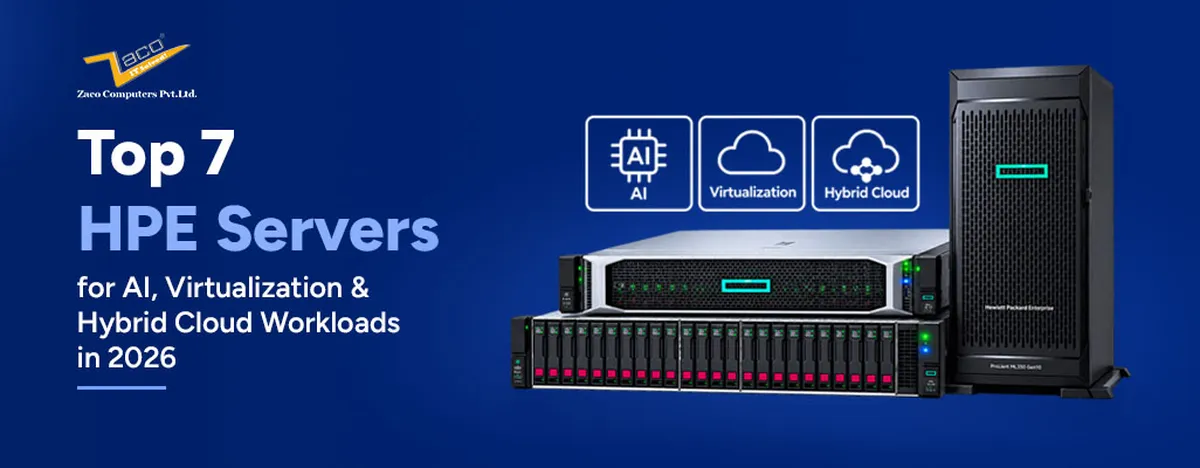
Choosing an HPE server in 2026 depends largely on the workload. AI environments need strong GPU and I/O support, virtualization environments usually benefit from high core counts and memory capacity, while hybrid cloud deployments place more emphasis on remote management and operational control.
HPE's ProLiant portfolio spans multiple generations and server configurations, each suited to different infrastructure requirements. This guide focuses on selected Gen10, Gen10 Plus and Gen11 models that remain relevant for the workloads discussed here, with the right choice depending on the applications, expansion requirements and available budget.
Choosing the right platform also helps avoid overbuying or undersizing. An AI-focused server may be unnecessary for a general virtualization environment, while a server with limited GPU or expansion support can become restrictive if AI workloads are added later.
Getting the model and generation right can help avoid two common problems: spending more on a server than the workload actually requires, or choosing a configuration that leaves little room for future requirements such as GPU-accelerated inference. Looking at the expected workload, expansion needs and likely growth before buying can help avoid both situations.
What to Look for in HPE Servers for AI, Virtualization & Hybrid Cloud
Before comparing individual HPE server models, it helps to know which specifications actually move the needle for each workload type.
- ● AI. GPU support, PCIe Gen5 lanes, and enough power and cooling headroom to run accelerators at full load without throttling.
- ● Virtualization. Core count, RAM capacity, and VM density per rack unit matter more than raw clock speed.
- ● Hybrid cloud. iLO remote management, HPE Compute Ops Management, and Silicon Root of Trust security determine how easily a server fits into a centrally managed, multi-site environment.
Overlooking any one of these dimensions tends to show up later as a bottleneck that a firmware update or software tweak can't fix.
The server generation also affects the overall configuration and cost. Gen11 platforms bring features such as DDR5 memory and PCIe Gen5 connectivity, while Gen10 Plus platforms use DDR4 memory and PCIe Gen4. Gen10 remains an established option for organizations looking for lower-cost configurations.
The newer generation is not automatically the better choice for every workload. The decision should be based on the required performance, expansion options and available budget.
The Top 7 HPE Servers for 2026 (Ranked by Workload Fit)
The following seven HPE ProLiant servers are worth considering in 2026. They cover different requirements, from GPU-accelerated workloads and virtualization to compact rack deployments and SMB environments.
1. HPE ProLiant DL380 Gen11 – Best All-Round for AI + Virtualization
The HPE ProLiant DL380 Gen11 is HPE's 2U flagship, built on 4th and 5th Gen Intel Xeon processors with DDR5 memory, PCIe Gen5 connectivity, and iLO 6 management. With support for up to eight single-wide GPUs, it comfortably handles AI inference and dense virtualization in the same chassis, making it the safest default pick for most enterprise buyers this year. Its balance of compute, memory bandwidth, and GPU flexibility means it rarely needs to be swapped out as workloads evolve.
2. HPE ProLiant DL385 Gen11 – Best for AI Reasoning & GPU Density
Built around AMD EPYC processors, the HPE ProLiant DL385 Gen11 is HPE's AI-optimized 2U platform, supporting high-end NVIDIA GPUs including Blackwell-class accelerators. For organizations prioritizing AI reasoning and inference performance over general-purpose virtualization, this is the strongest model in the current line-up, offering higher core counts and GPU density than the Intel-based DL380.
3. HPE ProLiant DL380 Gen10 Plus – Best Value for Modern Virtualization
The HPE ProLiant DL380 Gen10 Plus pairs 3rd Gen Intel Xeon processors with PCIe Gen4 connectivity, delivering strong VM density at a noticeably lower cost than Gen11. It remains one of the best value picks for virtualization-heavy environments that don't need PCIe Gen5 bandwidth, and it's a common refresh target for teams retiring older Gen9 or early Gen10 hardware.
4. HPE ProLiant DL380 Gen10 – Best Budget Workhorse
A proven 2U dual-socket platform, the HPE ProLiant DL380 Gen10 remains a dependable choice for general enterprise workloads and lighter inference or graphics tasks, particularly as a certified refurbished unit for budget-conscious deployments. Its long production run means spare parts and technical familiarity are both easy to find.
5. HPE ProLiant DL385 Gen10 – Best High-Core-Count Value (AMD)
The HPE ProLiant DL385 Gen10 brings AMD EPYC's high core density to virtualization and analytics workloads at a meaningfully lower price point than newer AMD-based platforms, making it a strong budget pick for core-hungry workloads that don't require the latest GPU support.
6. HPE ProLiant ML350 Gen10 – Best Tower for SMB & Edge Hybrid Cloud
The HPE ProLiant ML350 Gen10 is a tower server designed for organizations that do not need a traditional rack-based deployment. Its expandable configuration makes it suitable for SMB environments, branch offices and selected edge workloads.
The tower form factor can also be useful where a dedicated rack is not practical or where the server needs to be deployed closer to users or local applications.
7. HPE ProLiant DL360 Gen11 – Best Dense 1U Compute
Where rack space is at a premium, the DL360 Gen11 packs Gen11's PCIe Gen5 and DDR5 platform into a 1U footprint, making it the right pick for space-constrained environments that still need high-density virtualization performance, such as colocation facilities or edge data centers.
HPE Servers Price & Value: New vs Refurbished
There's no single number behind HP servers price — it varies substantially by generation, CPU tier, RAM configuration, GPU selection, and whether the unit is new or certified refurbished. As a general pattern, Gen11 hardware commands a real premium for its DDR5 and PCIe Gen5 capability, while refurbished Gen10 and Gen10 Plus units deliver strong value for workloads that don't need the newest I/O bandwidth. Because configurations vary so widely, the most reliable way to budget is to request a quote for your specific workload rather than relying on generic list pricing. Mixing new Gen11 units for AI-critical roles with refurbished Gen10 hardware for everything else is often the most cost-effective way to build out a fleet.
How to Match an HPE Server to Your Workload
The choice becomes simpler when the workload is defined first:
- ● GPU-accelerated AI and compute-intensive workloads: HPE ProLiant DL385 Gen11.
- ● Balanced virtualization and general enterprise workloads: HPE ProLiant DL380 Gen11.
- ● Value-focused virtualization: HPE ProLiant DL380 Gen10 Plus and DL385 Gen10.
- ● Tower-based deployments: HPE ProLiant ML350 Gen10.
- ● Limited rack space: HPE ProLiant DL360 Gen11.
Choosing the Right HPE Server for 2026
Refurbished Gen10 and Gen10 Plus platforms remain the most effective way to stretch a hardware budget without giving up meaningful performance, while Gen11 becomes more relevant when newer CPU, memory, PCIe or GPU capabilities are required.
Most enterprises don't need to pick one generation exclusively — running a mixed fleet, with Gen11 handling AI and latency-sensitive workloads while Gen10 covers general virtualization and back-office applications, is a common and cost-effective strategy for 2026 and beyond.
If you are comparing new and refurbished HPE servers, start with the workload, required configuration and expected growth. You can then request a quote based on the configuration you actually need.