

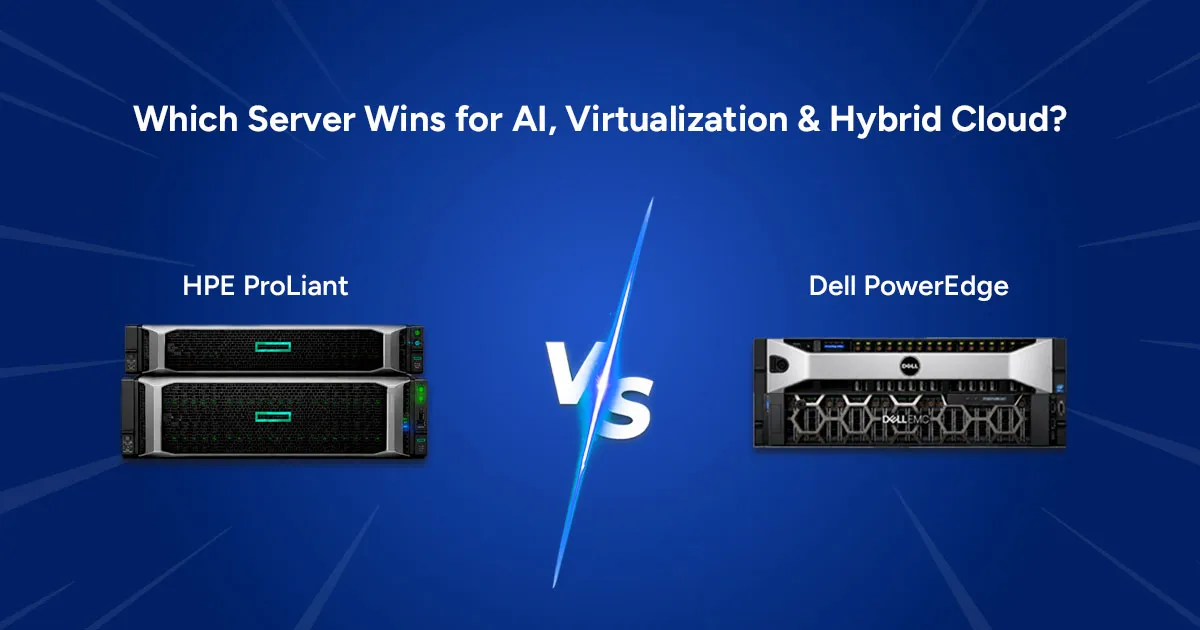
Dell PowerEdge vs HPE ProLiant is one of the most persistent debates in enterprise IT procurement, and in 2026 it's more nuanced than a simple spec comparison. There is no universal winner, the right pick depends on workload, existing ecosystem, and budget. Both platforms offer strong options for AI, virtualization, and hybrid cloud environments, while Dell stands out for its broad configuration options and iDRAC ecosystem and HPE offers a strong ProLiant portfolio with iLO and hybrid cloud management capabilities. This guide compares both platforms head-to-head across AI, virtualization, and hybrid-cloud management, then breaks down pricing and refurbished options so you can make the right call for your fleet.
Both vendors have spent years building out mature, enterprise-grade ecosystems around their hardware, which means the decision rarely comes down to a single benchmark. It's a combination of raw performance, management tooling familiarity, existing support contracts, and increasingly how each platform interacts with software licensing costs.
Virtualization licensing changes in recent years have quietly become one of the biggest factors driving hardware selection. As per-core and per-VM licensing costs shift, organizations are increasingly evaluating Dell PowerEdge server and HP ProLiant servers not just on raw hardware performance, but on which platform lets them run the same workloads on fewer, denser nodes directly reducing the licensing bill alongside the hardware bill. That shift has changed how procurement teams frame the comparison, moving the conversation from pure hardware specs toward total infrastructure cost, licensing included.
Meet the Contenders: PowerEdge & ProLiant Line-ups
Both Dell PowerEdge servers and enterprise servers from HPE's ProLiant range have well-established 2026 flagship rack platforms, and both families cover the same broad workload categories, the differences show up in architecture choices, management tooling, and configuration flexibility rather than in fundamentally different capability. Understanding each vendor's current line-up is the starting point before getting into how they compare on specific workloads.
Dell PowerEdge Servers (R-series & more)
Dell's PowerEdge R series includes established platforms such as the R660 and R760, alongside newer generation systems. PowerEdge servers are managed through iDRAC and OpenManage, with a broad range of configuration options for different enterprise workloads. That configuration breadth is a genuine advantage for organizations with unusual or highly specific hardware requirements, letting procurement teams tune CPU, memory, storage, and networking independently rather than choosing from a narrower set of fixed configurations.
HPE ProLiant Servers (DL380 / DL385)
HPE's ProLiant portfolio includes platforms such as the HPE ProLiant DL380 Gen11 and DL385 Gen11, which use iLO 6 for management and integrate with HPE GreenLake and Compute Ops Management for broader infrastructure management.
HPE's ProLiant portfolio offers a structured range of configurations across different workloads, while Dell's PowerEdge portfolio provides a broad selection of configurable options for organizations with specific hardware requirements.
Round 1: AI & GPU Workloads
Both vendors support modern NVIDIA GPUs on their current generation platforms, and both have invested heavily in validating their servers against the latest accelerator hardware as AI workloads have become a mainstream procurement driver rather than a niche use case. The HPE ProLiant server line, with systems such as the DL385 Gen11, supports a range of AI reasoning workloads through HPE's validated AI portfolio. Dell's XE and R series platforms are also designed for GPU intensive AI deployments, so the difference between the two vendors depends largely on the specific workload and server configuration. For most organizations, the deciding factor is likely to be the required GPU configuration, existing Dell PowerEdge vs HPE ProLiant environment, management tools, and overall cost rather than a major capability gap between the two platforms. Buyers evaluating this round closely should look at validated GPU compatibility lists and thermal design specifications for the exact configuration they need, rather than relying on generation level marketing claims from either vendor.
Round 2: Virtualization & Density
Both vendors offer AMD EPYC and Intel Xeon configurations across their PowerEdge and ProLiant portfolios, with support for major virtualization platforms such as VMware and Microsoft Hyper-V across supported configurations. There's no clear technical winner here the right choice comes down to core-count configuration, price at the specific configuration you need, and which management ecosystem your team already knows. Where virtualization licensing is charged per core or per VM, the platform that lets you hit your required VM density with fewer, denser nodes often wins on total cost even if its per-unit hardware price is slightly higher.
Round 3: Hybrid Cloud & Management
Dell's management stack centers on iDRAC and Open Manage Enterprise, while HPE's runs on iLO 6 with GreenLake and Compute Ops Management. On security, Dell offers Cyber Resilient Architecture and Secure Boot, while HPE counters with Silicon Root of Trust both are strong, silicon-anchored approaches. For hybrid cloud specifically, the choice between Dell APEX and HPE GreenLake is largely preference-based, since both platforms deliver comparable enterprise servers management capability across on-prem, edge, and cloud. Teams already invested in one ecosystem's consumption-based purchasing model will generally find switching vendors adds more operational friction than it's worth.
Value, Pricing & Refurbished Options
Both PowerEdge and ProLiant sit at the premium end of the enterprise server market, so real value comes down to configuration choices, support terms, and refurbished servers availability rather than list price alone. Refurbished units from either vendor typically cut cost by 40–60% versus new hardware, and many organizations run mixed fleets, Dell and HPE side by side to serve different workloads affordably without standardizing on a single vendor. This is particularly common when acquiring a new business unit or data center that already standardized on the other vendor, where consolidating everything onto one platform isn't worth the disruption.
Request a side-by-side quote to compare real configuration pricing across both platforms for your specific workload.
Final Verdict: Which Server Wins in 2026?
Both platforms are genuinely excellent, and the right choice depends on workload mix and existing ecosystem more than any single technical advantage. Many enterprises run mixed PowerEdge and ProLiant fleets rather than standardizing on one vendor exclusively, particularly when different business units have different histories and preferences.
In practice, existing infrastructure, management experience, workload requirements, and total cost often have more influence than a single benchmark.
For organizations starting fresh without an existing standard, the safest approach is to shortlist configurations from both vendors against the actual workload and licensing model in question, rather than picking a vendor first and working backward from there.
Request a quote and we'll help you compare Dell PowerEdge and HPE ProLiant configurations side by side.
Whichever platform you choose, the key considerations in 2026 are GPU compatibility for AI workloads, management tools your team can use effectively, and a support and refurbishment strategy that keeps total cost of ownership under control.