

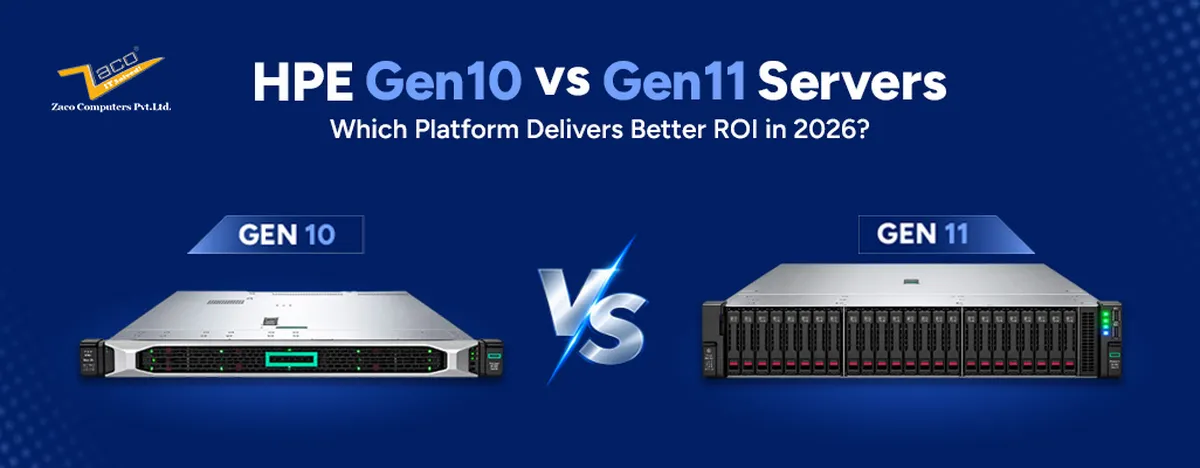
When evaluating HPE servers in 2026, the choice between Gen10 and Gen11 is not simply a question of choosing the newer generation. Both platforms can be suitable for enterprise workloads, but they offer different levels of performance, connectivity, memory technology and expansion capacity.
Gen11 introduces newer processor platforms, DDR5 memory, PCIe Gen5 connectivity and iLO 6, making it well suited to demanding workloads and new infrastructure deployments. Gen10 and Gen10 Plus, meanwhile, remain relevant for many established enterprise workloads where the required performance is already well understood and controlling capital cost is important.
The purchasing decision also needs to consider whether the server is being sourced new or refurbished. A properly configured refurbished HPE server can provide a lower acquisition cost without being simply a compromise for buyers with smaller budgets. For many workloads, it can be a practical way to add capacity, replace existing equipment or extend infrastructure without paying for capabilities that may not be needed.
This guide compares HPE Gen10 and Gen11 based on technology, workload requirements and total cost, so you can determine which platform makes better financial sense for your environment.
HPE Gen10 vs Gen11
Gen11 has the advantage when a workload requires newer processor technology, higher memory bandwidth, PCIe Gen5 connectivity, greater accelerator support or additional expansion capacity.
Gen10 and Gen10 Plus remain strong options for established virtualization, business applications, file services and other workloads that do not require the capabilities introduced with Gen11.
The procurement decision is separate from the generation decision. A business may choose a new Gen11 server, a refurbished Gen11 system where available, a new Gen10 configuration, or a refurbished Gen10 server. The right option depends on the workload, required configuration, budget and expected deployment period.
For this reason, ROI should be calculated around the workload rather than treating either generation as automatically better value.
Generation Overview: What Changed from Gen10 to Gen11?
HPE Gen10 and Gen10 Plus cover a broad range of Intel Xeon and AMD EPYC based platforms, depending on the specific server model. They use DDR4 memory, PCIe Gen3 or Gen4 connectivity and iLO 5 management.
Gen11 moves to newer Intel Xeon and AMD EPYC processor platforms, DDR5 memory, PCIe Gen5 connectivity and iLO 6. HPE states that Gen11 provides up to twice the I/O bandwidth and 33% higher high performance GPU density compared with the previous generation. The actual benefit depends on the server model and configuration, but these improvements are particularly relevant to AI, data intensive and highly consolidated workloads.
The important point is that these changes do not automatically make Gen11 the better choice for every deployment. The value comes from whether the workload can actually use the additional capacity.
HPE Gen10 & Gen10 Plus at a Glance
Gen10 and Gen10 Plus are established enterprise platforms with a wide range of configurations available across the secondary and refurbished hardware market. Their mature position in the market also means that many popular models have established availability for replacement components and expansion options.
For workloads with predictable requirements, this can make Gen10 an attractive procurement option. A refurbished Gen10 server can provide the required CPU, memory and storage capacity at a significantly lower acquisition cost than newer hardware, particularly when the workload does not benefit from Gen11's newer I/O and memory technologies.
That makes refurbished Gen10 hardware more than a low cost substitute. When the configuration matches the workload and the equipment has been properly tested and supported, it can be a sensible way to add capacity, replace ageing equipment or maintain a consistent hardware environment without paying for capabilities that may not be needed.
HPE ProLiant Gen11 at a Glance
Gen11 brings DDR5 memory, PCIe Gen5 connectivity, iLO 6 and newer processor options to the ProLiant portfolio. These improvements provide more capacity for workloads that depend on memory bandwidth, high-speed I/O, accelerators, or higher levels of server consolidation.
For a new deployment with growing performance requirements, Gen11 can provide more room for expansion and workload growth. It can also be worth considering for environments where the server is expected to remain in production for several years.
However, the additional capability comes with a higher acquisition cost. If the workload does not require those capabilities, the additional investment may not produce a meaningful return.
Performance & Workload Fit
The difference between Gen10 and Gen11 becomes clearer when the workload is considered. Some applications benefit significantly from additional memory bandwidth and I/O capacity, while others may run comfortably within the capabilities of Gen10.
The right question is therefore not which generation is faster in isolation, but whether the additional performance and expansion capacity of Gen11 will actually be used.
AI & GPU Workloads
Gen11 is generally better suited to demanding AI and GPU accelerated workloads because of its PCIe Gen5 connectivity, newer processor platforms and higher accelerator density. HPE states that Gen11 supports 33% more high performance GPU density per server compared with the previous generation.
Gen10 can still be suitable for smaller or less demanding AI deployments where GPU and I/O requirements are limited. However, as the number of accelerators and the amount of data being processed increase, Gen11's additional bandwidth becomes more valuable.
For organizations planning to introduce AI into an existing infrastructure, this is one area where buying a newer platform can be justified by the workload rather than simply by the age of the hardware.
Virtualization & General Enterprise Workloads
For standard virtualization and general enterprise workloads, the decision is less straightforward.
If the required VM density, memory capacity and storage performance can be achieved with Gen10, moving to Gen11 may not provide enough additional value to justify the higher acquisition cost. In these situations, a well configured refurbished Gen10 server can be a practical option.
Gen11 becomes more attractive when higher consolidation, additional memory capacity or faster I/O can reduce the number of physical servers required. The comparison should therefore be based on the actual workload and required configuration rather than the server generation alone.
Power, Cooling & Data Center Efficiency
Power and cooling should be considered alongside purchase price, particularly in larger deployments.
Gen11 can improve infrastructure efficiency when its additional compute, memory and I/O capacity allows workloads to be consolidated onto fewer physical servers. However, the actual saving depends on the server configuration, utilization and workload.
A lightly loaded Gen10 server may continue to be more economical overall if replacing it with Gen11 does not reduce the number of physical systems required. On the other hand, if Gen11 allows several workloads to be consolidated, the higher initial investment may be offset by lower power, cooling and rack requirements.
This is why power efficiency should be treated as part of the total ROI calculation rather than used as a reason to automatically replace older hardware.
New vs Refurbished: Where Does It Fit Into the ROI Calculation?
The generation comparison is only one part of the purchasing decision. The condition and source of the hardware can also have a significant impact on total acquisition cost.
For some deployments, a new Gen11 server is the logical choice because the workload requires the latest processor, memory and I/O capabilities. In other cases, a refurbished Gen11 system may provide access to the same generation at a lower acquisition cost, subject to availability and configuration.
The same principle applies to Gen10. A refurbished Gen10 server can make strong financial sense when its available configuration meets the workload requirements. The lower purchase price can free budget for additional memory, storage, networking or spare capacity instead of spending that budget entirely on a newer platform.
The important consideration is not whether hardware is new or refurbished in isolation. Buyers should look at the condition of the equipment, configuration, testing, warranty, support options, expected service life and how closely the hardware matches the workload.
A lower cost server is only good value when it does the job reliably. Equally, paying more for a newer generation does not create additional ROI if its extra capabilities are left unused.
How to Calculate the ROI
A useful comparison should go beyond the purchase price.
Start with the total acquisition cost of each option, including the server configuration, memory, storage, networking requirements and any additional components required for deployment.
Then consider:
- ● Expected workload and utilization
- ● Power and cooling requirements
- ● Number of physical servers required
- ● Warranty and support costs
- ● Expected deployment period
- ● Upgrade requirements
- ● Likely replacement or refresh date
A simple starting point is:
Payback period = Additional investment ÷ Annual savings
However, payback is only part of the calculation. If a refurbished Gen10 server meets the workload requirements for the expected deployment period, its lower acquisition cost may make it the stronger option. If the workload is expected to grow quickly and Gen11 avoids an earlier replacement, the higher initial investment may produce better long term value.
The objective is to find the platform that meets the requirement at the lowest sensible total cost, rather than simply choosing the newest or cheapest server.
The ROI Verdict for 2026
There is no single winner between Gen10 and Gen11.
Gen11 is the stronger choice when a workload requires newer processor technology, DDR5 memory, PCIe Gen5 connectivity, higher accelerator capacity or greater room for future expansion.
Gen10 remains relevant where workload requirements are well established and do not require those newer capabilities. In these cases, a refurbished Gen10 server can offer a practical way to meet infrastructure requirements while keeping capital expenditure under control.
There is also no requirement to standardize an entire environment on one generation. A business may use Gen11 for newer or more demanding workloads while continuing to use refurbished Gen10 systems for established applications where they remain technically suitable.
The best ROI therefore comes from matching the server to the workload and evaluating the complete cost of ownership. Generation, condition, configuration, warranty and expected service life all have a role in that decision.
Choosing the Right HPE Server
Choosing between Gen10 and Gen11 is only the first step. The actual configuration, condition and expected workload are equally important.
Zaco Computers supplies new and professionally refurbished enterprise IT hardware, including HPE ProLiant servers. The right configuration can be evaluated based on CPU, memory, storage, expansion requirements and budget, so the recommendation is based on what the infrastructure actually needs rather than the server generation alone.