

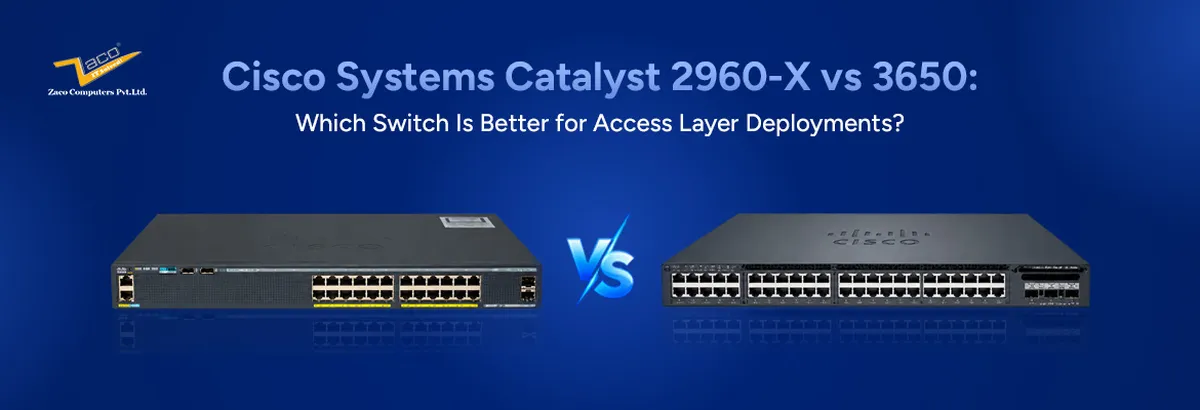
Choosing the right access layer switch depends on the size of the network, required features, PoE requirements, and budget. The Cisco Catalyst 2960 X and Catalyst 3650 are both enterprise class switches designed for campus, branch, and access layer deployments, but they offer different capabilities.
The Catalyst 2960 X is primarily designed for Layer 2 access switching, with Gigabit Ethernet ports, PoE+ options, and support for Cisco FlexStack Plus. The Catalyst 3650 offers broader Layer 3 capabilities, StackWise 160, redundant power options on supported models, and integrated wired and wireless features.
There is also an important lifecycle consideration. Cisco has discontinued both product families. The Catalyst 2960 X remains supported by Cisco until October 31, 2027, while the Catalyst 3650 reaches its last date of support on October 31, 2026. This makes lifecycle status an important factor when considering either platform for a new deployment.
In this guide, we compare the Catalyst 2960 X and 3650 across performance, Layer 2 and Layer 3 capabilities, PoE, stacking, management, lifecycle, and cost to help you determine which option is better suited to your network.
Overview of the Cisco Catalyst 2960-X and 3650 Series
Before comparing individual features, it is useful to understand the intended role of each switch.
Cisco Catalyst 2960-X: Reliable Layer 2 Access
The Catalyst 2960 X is a fixed configuration Gigabit Ethernet switch designed primarily for Layer 2 access deployments. It is available in 24 port and 48 port configurations, with PoE+ options on selected models and SFP or SFP+ uplinks depending on the model.
The platform supports Cisco IOS and can use FlexStack Plus for stacking up to eight switches with 80 Gbps of stack bandwidth. The 2960 XR variant adds the IP Lite feature set and should be considered separately when Layer 3 requirements are being evaluated.
Cisco Catalyst 3650: Layer 3-Capable Converged Access
The Catalyst 3650 is positioned for environments that need more than Layer 2. It runs the equally robust Cisco IOS XE operating system, supports full Layer 3 routing, offers a redundant power supply option for higher availability, and integrates wired and wireless connectivity on a single platform. Designed as an enterprise-class stackable access switch, it brings advanced QoS, Flexible NetFlow, full IPv4/IPv6 routing, and Cisco StackWise-160 stacking to the access layer. It is a suitable choice when you specifically need a switch that can act as both an access and a distribution device, or when redundant power and advanced routing are part of your requirements.
Performance and Switching Capacity Comparison
Performance varies by specific model, so comparing the two families using a single switching capacity figure can be misleading.
For the Catalyst 2960 X LAN Base family, Cisco specifies up to 108 Gbps of forwarding bandwidth and 216 Gbps of full duplex switching bandwidth. Forwarding rates vary by model, with 24 port and 48 port configurations offering different performance levels.
The Catalyst 3650 family also has different performance levels depending on the model and uplink configuration. Cisco's specifications show forwarding rates ranging from approximately 41.66 Mpps on some 24 port models to substantially higher rates on models with higher speed uplinks.
For this reason, performance should be evaluated based on the exact switch model, uplink requirements, expected traffic, and connected devices rather than the series name alone.
For a typical access layer deployment using Gigabit Ethernet connections, both platforms can provide sufficient switching performance. The more important difference is the feature set. The 3650 provides greater Layer 3 and convergence capabilities, while the 2960 X is generally better suited to straightforward access switching.
Layer 2 vs Layer 3 Capabilities
This is the most important architectural distinction between the two switches, and it is largely a question of what your access layer actually needs to do.
The Catalyst 2960-X is purpose-built as a Layer 2 switch. It handles VLANs, Spanning Tree Protocol, port security, and other access-layer features very well, and for the vast majority of access layer deployments, Layer 3 routing is simply not required at this point in the network. The 2960-XR variant adds limited static routing and basic protocols like RIPng and EIGRP Stub for environments that need a touch of routing without moving up to a full Layer 3 platform.
The Catalyst 3650 was designed with broader Layer 3 capabilities. Depending on the software and licensing configuration, it can support functions such as inter VLAN routing, static routing, OSPF, EIGRP, and IPv4 and IPv6 routing.
This makes the 3650 more suitable for networks where routing is performed closer to the access layer.
In simple terms, choose the 2960 X when the access switch mainly needs to connect users and devices to the network. Consider the 3650 when the access layer also needs to perform more advanced routing or convergence functions.
PoE and PoE+ Capabilities
Power over Ethernet has become essential thanks to the surge of IP phones, wireless access points, security cameras, and IoT sensors connecting to the access layer.
Selected Catalyst 2960 X models support IEEE 802.3af PoE and IEEE 802.3at PoE+. However, the available PoE power budget and number of ports that can deliver PoE+ vary by model. For example, Cisco lists different power budgets across the 24 port and 48 port PoE models.
The Catalyst 3650 also supports full 802.3at PoE+ at 30W per port, and on selected models adds Cisco UPOE delivering up to 60W per port. UPOE is useful when you need to power higher-draw devices such as virtual desktops, advanced PTZ cameras, digital signage, or compact access points that exceed PoE+ limits.
For deployments centred on standard IP phones, cameras, and Wi-Fi access points, the 2960-X provides plenty of power at a lower price. For deployments with a significant number of next-generation Wi-Fi 6 access points or high-power IoT endpoints, the 3650 with UPOE offers additional headroom.
Stacking and Scalability
Both switches support stacking, with technologies sized to their respective roles.
The 2960-X uses Flex Stack-Plus (or Flex Stack-Extended on selected models), which allows up to 8 switches to be stacked with a stack bandwidth of around 80 Gbps. This is a solid and proven solution for branches and mid-sized offices that need single-pane management of multiple switches at the access layer.
The Catalyst 3650 uses Cisco StackWise-160, providing 160 Gbps of stack throughput and supporting up to 9 switches in a single stack. StackWise-160 also offers strong redundancy, fast failover, and integration with Cisco DNA Centre for automation and analytics, which can be helpful for multi-floor enterprises and organizations planning significant growth.
Software, Management, and Lifecycle
The two platforms use different software architectures.
The Catalyst 2960 X runs Cisco IOS and is well suited to conventional Layer 2 access switching and established network management practices. Cisco's documentation lists IOS 15.2 releases for the platform.
The Catalyst 3650 was built around Cisco IOS XE and provides broader capabilities for programmability, telemetry, wired and wireless convergence, and Cisco network management platforms.
However, lifecycle status is now an important consideration. Cisco lists the Catalyst 3650 as reaching its last date of support on October 31, 2026. The Catalyst 2960 X is also end of sale, but Cisco currently lists October 31, 2027 as its last date of support.
Therefore, neither platform should be presented as a long-term future-ready choice for a new enterprise deployment. For organizations considering refurbished hardware, lifecycle dates should be checked alongside price, condition, configuration, and expected deployment period.
Security Features
Security at the access layer is where threats are stopped before they propagate, and both switches come well equipped.
The 2960-X offers a strong toolkit including 802.1X authentication, MACsec encryption on uplinks, MAC-based VLAN assignment, BPDU Guard, DHCP Snooping, Dynamic ARP Inspection, and Cisco TrustSec. These features cover the vast majority of enterprise access security requirements.
The 3650 builds on the same foundation and adds MACsec on downlinks, expanded TrustSec capabilities, deeper NetFlow visibility, and tighter integration with Cisco Identity Services Engine (ISE) and Cisco DNA Center for unified policy enforcement. For regulated industries such as finance, healthcare, and government that need this expanded posture, the 3650 is a strong option.
Cost and Total Cost of Ownership
Cost is an important consideration when choosing between these older Cisco platforms, particularly in the refurbished market.
The Catalyst 2960 X is generally attractive for organizations that need Gigabit access switching, PoE+, and stacking without requiring extensive Layer 3 functionality. Its simpler feature set can also make it easier to deploy in conventional access layer environments.
The Catalyst 3650 can offer additional capabilities such as Layer 3 routing, StackWise 160, and selected higher power options. However, these benefits need to be evaluated alongside the platform's lifecycle status. Cisco lists October 31, 2026 as the last date of support for the Catalyst 3650.
For refurbished equipment, buyers should compare the exact model, hardware configuration, condition, warranty, available support, and remaining lifecycle rather than choosing purely on purchase price.
Need expert guidance on the right Cisco switch for your network?
Get a Personalized Quote from Zaco Computers Today!
Which Switch Should You Choose?
Consider the Cisco Catalyst 2960-X if you need:
- Reliable Layer 2 access for small to mid-sized offices, which covers the majority of access layer deployments
- A cost-effective option with PoE+ for IP phones and standard access points
- Simple operations on the robust and familiar Cisco IOS
- A proven, dependable workhorse where advanced Layer 3 routing is not required
- A platform with Cisco support currently listed through October 31, 2027
Consider the Cisco Catalyst 3650 if you need:
- Full Layer 3 routing at the access layer
- A redundant power supply option for higher availability
- Higher-density deployments with 48 Gbps switching capacity
- UPOE for high-power devices like Wi-Fi 6 APs and PTZ cameras
- Cisco DNA Center, SD-Access, and automation readiness
- Scalable stacking up to 9 switches with 160 Gbps stack bandwidth
In short, the 2960-X is a smart, economical choice for standard Layer 2 access environments, which is what most access layers are, while the 3650 is the right pick for organizations that specifically need Layer 3 functionality, redundant power, or a future-ready converged access platform.
Conclusion
The Cisco Catalyst 2960 X and Catalyst 3650 were designed for different access layer requirements.
The Catalyst 2960 X is primarily focused on Layer 2 access switching, with Gigabit Ethernet connectivity, PoE+ options, and FlexStack Plus stacking. It remains a practical option for organizations looking for established Cisco hardware for conventional access layer deployments.
The Catalyst 3650 provides broader Layer 3 routing, StackWise 160, and wired and wireless convergence capabilities. However, its lifecycle should be considered carefully because Cisco lists October 31, 2026 as its last date of support.
For organizations considering refurbished Cisco hardware, the decision should therefore be based on the exact model, required features, available configuration, condition, warranty, price, and remaining support lifecycle.
Zaco Computers can help businesses evaluate Cisco switch configurations based on their network requirements and budget, including new and refurbished enterprise networking hardware.
Need Help Choosing the Right Cisco Switch?
Compare available Cisco Catalyst configurations based on your port count, PoE requirements, network architecture, budget, and lifecycle requirements.
Talk to Zaco Computers about available Cisco switch options.