

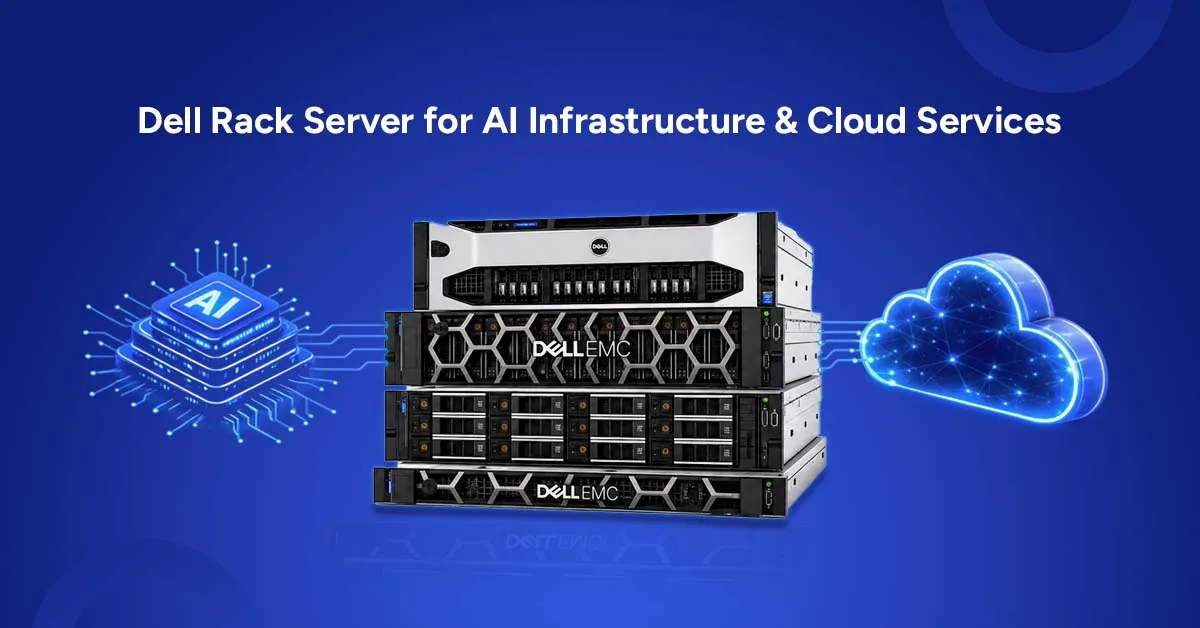
Dell has been voted both Market Leader and Innovation Leader for Servers for AI in the 2025 IT Brand Pulse Enterprise Infrastructure Report, capturing over half of all market leadership votes among verified IT professionals globally. That recognition reflects the reality that Dell PowerEdge rack servers are deployed at the centre of more enterprise AI, cloud, and mission-critical workloads than any competing platform.
But the range of Dell rack servers is wide, the specifications are dense, and the choice between models and between new versus certified refurbished is consequential. Choosing the wrong platform for an AI inference cluster costs money and time. Choosing more platform than the workload needs wastes capital that could be deployed elsewhere. This guide gives you a structured path from workload requirement to model selection for both AI infrastructure and cloud services.
How to Choose the Right Dell Rack Server for AI Infrastructure
AI workloads are heterogeneous they include data ingestion, pre-processing, model training, inference serving, and monitoring and each phase has distinct hardware requirements. The framework below moves from workload classification to specific hardware parameters.
Step 1: Classify Your AI Workload Phase
AI infrastructure requirements differ significantly based on where in the pipeline the server operates. The three primary phases are training, inference, and data preparation.
- AI model training: Compute-intensive, GPU-bound workload. Requires high PCIe bandwidth for GPU communication, large memory for model parameters, and high-throughput storage for dataset access. The R740 with GPU accelerators or the R840 for large model training is the primary candidates.
- AI inference serving: Latency-sensitive, throughput-driven workload. GPU acceleration is beneficial but not always mandatory for smaller models. The R640 or R740 with 1–2 GPU cards handles most enterprise inference scenarios efficiently. NVMe storage is critical for fast model loading.
- Data preparation and ETL: I/O-bound workload requiring high storage throughput and memory bandwidth. The R740xd or R730xd with high-density storage configurations are ideal. CPU performance matters more than GPU count for these tasks.
Step 2: Define Your Memory and Storage Baseline
Memory capacity is the most common bottleneck in AI deployments. Insufficient RAM forces constant data paging, which destroys the performance advantage of GPU acceleration. Treat 256 GB of RAM per server as the floor for production AI workloads, with 384 - 512 GB recommended for virtualisation hosts running AI workloads.
Storage must be evaluated on two dimensions: latency and throughput. For AI model storage and dataset serving, NVMe PCIe drives provide the lowest latency and highest throughput. For backup, checkpointing, and archive storage, high-capacity SAS or SATA HDDs are the most cost-effective option. The R740 and R740xd support mixed NVMe and SAS/SATA configurations, enabling tiered storage within a single chassis.
Step 3: Evaluate GPU and PCIe Expansion Requirements
For inference, NVIDIA V100, T4, or A10 class accelerators provide an excellent performance-to-cost ratio and are widely available in the certified refurbished market. For training workloads requiring higher memory bandwidth, NVIDIA A100 class accelerators in PCIe form factor are compatible with the R740 platform.
Verify PCIe slot count and bandwidth before finalising GPU configuration. The R740 provides up to 8 PCIe Gen3 slots, supporting up to three double-width GPUs. The R840 provides additional expansion capacity for larger GPU configurations. Confirm that the PSU wattage covers GPU thermal design power, inadequate PSU capacity is a common configuration oversight.
Step 4: Select the Network Configuration
AI workloads generate significant east-west traffic between compute nodes, storage systems, and orchestration layers. 1GbE is insufficient. The minimum recommended configuration is 10GbE, with 25GbE preferred for training clusters and high-volume inference farms. Dell PowerEdge R740 and R640 servers support 10GbE, 25GbE, and 100GbE adapters through Flexible LOM and PCIe stand-up positions. For Kubernetes or container orchestration, ensure the NIC supports SR-IOV for hardware-level network virtualisation.
AI Workload to Server Mapping
|
Workload Type |
Recommended Model |
Key Requirement |
Min Config |
|
AI Inference / Light ML |
R740 / R640 |
GPU slots + fast NVMe |
2x Xeon Gold, 256 GB RAM |
|
AI Model Training |
R740 / R840 |
Multi-GPU, high RAM |
2–4P Xeon, 512 GB+ RAM |
|
Big Data / Analytics |
R740xd / R730xd |
Storage density, throughput |
24+ drive bays, 10GbE |
|
Data Prep / ETL |
R740xd / R730xd |
I/O bandwidth, memory |
2x Xeon, 384 GB RAM |
|
In-memory DB / SAP HANA |
R840 / R930 |
4-socket, large RAM pool |
4P Xeon, 1.5 TB+ RAM |
How to Choose the Right Dell Rack Server for Cloud Services
Cloud service delivery whether private cloud, hybrid cloud, or hosted services, places specific demands on rack server architecture that differ from on-premises applications. The key variables are node density, network I/O, storage scalability, and management automation.
Private Cloud - OpenStack and VMware vCloud
Private cloud deployments require high memory capacity per node to support VM density, fast local storage for ephemeral compute instances, and 10GbE or higher networking for overlay network performance. The R740 is the standard choice: dual Xeon Scalable processors, up to 3 TB RAM, NVMe storage options, and robust iDRAC9 management simplify OpenStack and VMware vCloud deployments.
For organisations building private cloud infrastructure on a capital-constrained budget, certified refurbished R740 or R730 servers deliver the specification needed at a fraction of new hardware cost. The secondary market supply of these models ensures no compromise on configuration options.
Hybrid Cloud and Edge Nodes
Hybrid cloud architectures require servers at the edge that can run local workloads while maintaining connectivity to public cloud orchestration layers. The R640 in a 1U form factor is ideal for edge rack deployments where space is constrained and compute density is a priority. Its compatibility with VMware vSphere and Microsoft Azure Stack makes it a natural fit for hybrid deployments.
Hosted SaaS and Web Infrastructure
For SaaS platforms, e-commerce infrastructure, or high-traffic web applications, the R630 or R730 provides the right balance of compute performance and storage flexibility at a price point that makes horizontal scaling economically viable. These models support the full range of enterprise OS configurations and hypervisors with no compromise on management capability.
Cloud Workload to Server Mapping
|
Workload Type |
Recommended Model |
Key Requirement |
Min Config |
|
Private Cloud (OpenStack/VMware) |
R740 / R640 |
10GbE+, NVMe storage |
25GbE NICs, SSD storage |
|
Virtualisation (VMware/Hyper-V) |
R730 / R740 |
High RAM, core count |
2x Xeon, 384–512 GB RAM |
|
Hybrid / Edge Compute |
R640 / R430 |
Low footprint, high I/O |
1U chassis, SSD-only |
|
Web Hosting / SaaS |
R630 / R730 |
Balanced compute + storage |
2x Xeon, 128 GB RAM |
|
Database (SQL/Oracle) |
R840 / R930 |
4-socket, large RAM pool |
4P Xeon, 1.5 TB+ RAM |
Dell PowerEdge Rack Server Line-up at a Glance
Dell PowerEdge rack servers are organised by socket count and form factor. The naming convention is consistent: the first digit indicates socket count (6 = 1-socket, 7 = 2-socket, 8 = 3-socket, 9 = 4-socket), and the next digits indicate the generation.
- 1U servers: R640 (1U, 2-socket) and R660 deliver maximum compute density that ideal for AI inference nodes, edge computing, and HPC clusters where compute density drives ROI.
- 2U servers: R730, R740, R740xd, and R750 balance compute performance, memory, storage flexibility, and GPU expansion. The R740 is the flagship with dual Xeon Scalable, up to 3 TB DDR4, 16 x 2.5" or 8 x 3.5" drives plus NVMe, and PCIe slots for GPUs.
- 4-socket servers: R840 (2U) and R930 (4U) address workloads needing extreme memory capacity and large in-memory databases, SAP HANA, Oracle RAC, and AI training that benefits from massive shared memory. The R840 supports up to 6 TB of DDR4 across 48 DIMM slots.
Quick Model Reference
|
Model |
Form |
Sockets / CPU |
Max RAM |
Best For |
|
PowerEdge R740 |
2U |
2 (Xeon Scalable) |
3 TB DDR4 |
AI/ML, VDI, Cloud - versatile flagship |
|
PowerEdge R740xd |
2U |
2 (Xeon Scalable) |
3 TB DDR4 |
Big Data, Storage - dense storage + compute |
|
PowerEdge R730 |
2U |
2 (Xeon E5 v4) |
1.5 TB DDR4 |
Virtualisation, DB and cost-effective Gen13 |
|
PowerEdge R730xd |
2U |
2 (Xeon E5 v4) |
1.5 TB DDR4 |
SDS, Backup - storage-dense Gen13 |
|
PowerEdge R840 |
2U |
4 (Xeon Scalable) |
6 TB DDR4 |
HPC, In-memory DB 4-socket scale-up |
|
PowerEdge R930 |
4U |
4 (Xeon E7 v4) |
6 TB DDR4 |
SAP HANA, ERP mission-critical 4P |
|
PowerEdge R640 |
1U |
2 (Xeon Scalable) |
3 TB DDR4 |
Dense HPC, Inference with 1U high-performance |
|
PowerEdge R750 |
2U |
2 (Xeon 3rd Gen) |
4 TB DDR4 |
AI Inference and latest-gen upgrade path |
Certified Refurbished Dell Rack Servers vs New
For the majority of enterprise AI and cloud workloads, certified refurbished Dell rack servers are the strategically superior procurement decision not a compromise. Dell PowerEdge Gen13 and Gen14 servers (R730, R740, R740xd, R840, R640) are deployed in production at the world's largest enterprises. They are proven at scale and supported by the most extensive secondary market parts ecosystem of any server platform. The technology inside them Intel Xeon Scalable, PCIe Gen3, DDR4, NVMe, iDRAC9 runs the vast majority of enterprise AI and cloud workloads today.
The 40–65 percent cost reduction is not marginal. For a 20-node AI inference cluster, it is the difference between a project that gets funded and one that does not and it is the saving that enables procurement of additional nodes, GPU accelerators, or NVMe storage that directly improve workload performance.
Certified Refurbished Dell Rack Servers at Zaco Computer
Zaco Computer maintains active inventory of certified refurbished Dell PowerEdge rack servers across 1U, 2U, and 4U form factors including R930, R840, R740, R740xd, R730, R730xd, and R640 available for immediate dispatch in customised configurations.
Every server goes through a documented multi-stage process: hardware inspection of chassis, processors, memory, storage controllers, drives, PSUs, and cooling; replacement of failed components with verified genuine parts; firmware update to the latest stable baseline; and performance testing under simulated production load. Test documentation is available on request, and warranty coverage is provided as standard.
Zaco Computer operates with dedicated teams in India, the United Kingdom, and the UAE, providing technical pre-sales consultation, configuration advice, and post-sale support across all three regions. Volume pricing and phased delivery scheduling are available for bulk procurement.
Building AI inference or private cloud infrastructure and need a cost-effective starting point?
Zaco Computer's certified refurbished Dell PowerEdge servers are tested, firmware-updated, and warranty-backed ready to form the compute foundation of your AI or cloud platform. Contact us for a configuration recommendation.
Conclusion
Choosing the right Dell rack server for AI infrastructure and cloud services is a decision that rewards precision. The wrong platform creates bottlenecks insufficient memory, inadequate PCIe expansion for GPUs, or storage configurations that throttle the AI pipeline. The right platform, correctly configured, becomes an infrastructure asset that delivers measurable performance and operational reliability for years.
Dell's PowerEdge R-series provides the most versatile and well-documented rack server platform for enterprise AI and cloud deployments. The R740 is the benchmark for AI inference and private cloud. The R640 is the density play for scale-out clusters. The R840 and R930 are the right answer for memory-intensive database and large-model workloads. The R730 and R730xd remain excellent value for virtualisation and storage-intensive deployments. For the majority of these use cases, certified refurbished Dell rack servers from Zaco Computer deliver the same workload performance as new hardware at 40–65 percent lower cost.
Frequently Asked Questions (FAQs)
Q.1 What Dell rack server is best for AI inference workloads?
The Dell PowerEdge R740 is the most versatile choice for enterprise AI inference. It supports dual Intel Xeon Scalable processors, up to 3 TB DDR4 memory, NVMe storage, and up to three double-width GPU accelerators in a 2U form factor. The R640 is preferred when node density is the priority.
Q.2 Can a certified refurbished Dell rack server handle production AI and cloud workloads?
Yes, when properly tested. Dell PowerEdge Gen13 and Gen14 servers run Intel Xeon Scalable processors, DDR4 ECC memory, NVMe storage, and PCIe GPU expansion handling the vast majority of enterprise AI inference, virtualisation, and private cloud workloads. The key is the refurbishment standard: full diagnostics, component replacement where needed, firmware updates, and burn-in testing.
Q.3 What is the difference between the Dell PowerEdge R740 and R740xd?
Both are 2U, 2-socket servers with the same processor and memory specifications. The R740 is optimised for compute with up to 16 x 2.5" or 8 x 3.5" drives. The R740xd adds significantly more storage up to 26 x 2.5" or 12 x 3.5" drives plus rear bays making it ideal for big data, software-defined storage, and storage-intensive workloads.
Q.4 How much can an organisation save by buying certified refurbished Dell rack servers?
Certified refurbished Dell rack servers typically cost 40–65 percent less than equivalent new hardware. For a 20-node AI inference cluster, that saving can fund additional GPU cards, NVMe storage, or network upgrades that directly improve workload performance.
Q.5 What GPU accelerators are compatible with Dell PowerEdge R740 servers?
The R740 supports NVIDIA Tesla and Quadro series GPUs including V100, T4, A10, and A30 in PCIe form factor as well as AMD FirePro and Instinct accelerators. For AI inference, NVIDIA T4 and A10 provide excellent performance-to-power ratios. The R740 supports up to three double-width GPU cards, with PSU capacity as the primary constraint.