

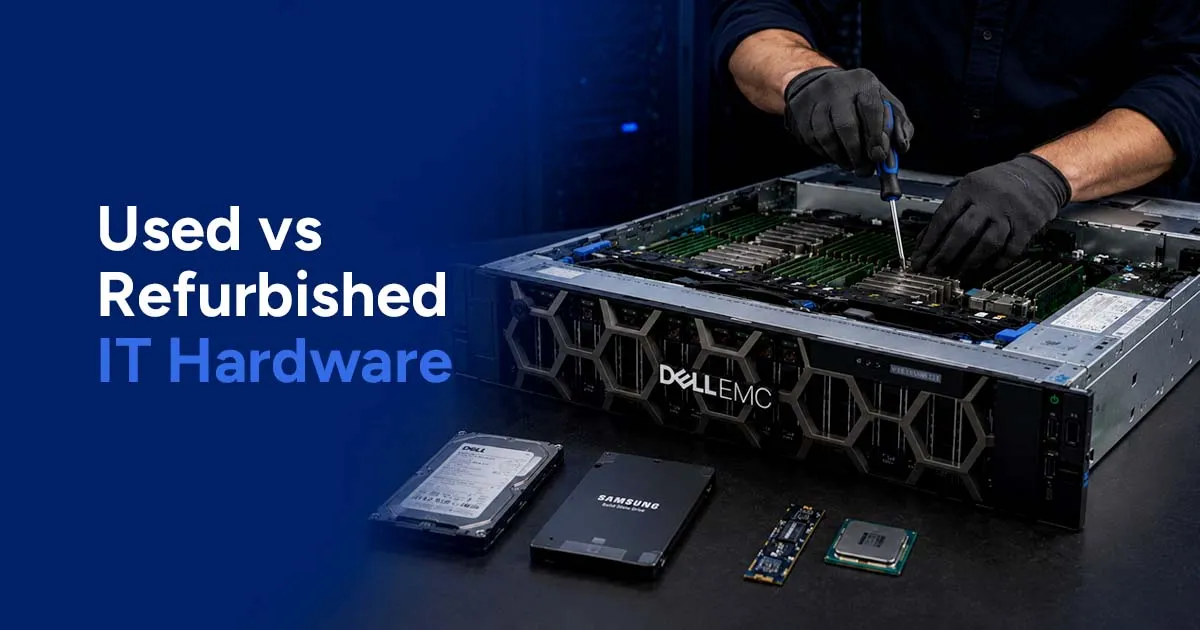
The demand for cost-effective IT infrastructure is growing rapidly across businesses of every size. Whether you run a small start-up or manage a large data centre, the rising cost of brand-new servers, storage systems, and networking equipment often pushes you toward more affordable options. Two terms appear repeatedly in this space: used IT hardware and refurbished IT hardware. They sound similar, but they describe two very different products.
Many buyers use these terms interchangeably, which can lead to poor purchase decisions and unexpected downtime. The truth is, the gap between used and refurbished IT hardware affects everything from price and reliability to warranty and long-term value. According to Market Research Future, the global refurbished electronics market was valued at USD 124.61 billion in 2024 and is projected to reach USD 487.47 billion by 2035, growing at a CAGR of 13.2%.
This guide explains the real differences between these two categories, helps you understand which option fits your business needs, and shows you how to make a confident purchasing decision.
What Is Used IT Hardware?
Used IT hardware refers to equipment that has been previously owned and is being resold without any restoration, deep testing, or formal certification process. When a company upgrades its infrastructure or shuts down a data centre, the old servers, hard drives, memory modules, and networking devices are often sold as-is to clear inventory quickly.
The seller of used hardware typically does not take responsibility for the equipment's prior workload, wear and tear, or remaining lifespan. The device may still contain old configurations, leftover data, or undiagnosed issues. While the upfront price is the lowest available in the secondary market, the long-term risks can be significant.
Key Characteristics of Used IT Hardware
- ● Sold in its existing condition without component-level repair or replacement.
- ● Limited or no warranty coverage from the seller, leaving the buyer responsible for failures.
- ● No standardised testing process, making performance and reliability difficult to predict.
- ● Lower upfront cost compared to both new and refurbished alternatives.
- ● Best suited for non-critical use cases such as lab setups, learning environments, or short-term projects.
What Is Refurbished IT Hardware?
Refurbished IT hardware is pre-owned equipment that has gone through a structured restoration process before being resold. A professional refurbisher inspects every unit, replaces worn or faulty components, performs deep diagnostics, cleans the hardware inside and out, and resets the system to its original factory settings. The goal is to bring the equipment as close to new condition as possible.
Unlike used hardware, refurbished equipment comes with a warranty, defined quality standards, and post-sale support. Many refurbishers also offer Annual Maintenance Contracts (AMC) and third-party support, which makes refurbished IT hardware suitable for production environments and business-critical workloads.
The Standard Refurbishment Process
A reliable refurbishment workflow usually includes the following stages:
- ● Initial physical inspection to identify bent pins, damaged casings, and structural defects
- ● Deep component-level diagnostics including memory stress testing, storage health checks, and CPU performance validation
- ● Replacement of consumable parts such as CMOS batteries, thermal paste, and worn cooling fans
- ● Complete cleaning of internal components and resetting to original factory configuration
- ● Final quality assurance, packaging, and warranty assignment before shipment
Core Differences Between Used and Refurbished IT Hardware
Understanding the side-by-side differences helps you evaluate which type of IT hardware aligns with your business goals, technical requirements, and risk tolerance. The table below summarises the most important distinctions buyers should consider.
|
Parameter |
Used IT Hardware |
Refurbished IT Hardware |
|---|---|---|
|
Condition |
Sold as-is, no restoration |
Inspected, repaired, and restored |
|
Testing |
Often untested before sale |
Component-level and stress tested |
|
Warranty |
Usually none or very limited |
Standard warranty included |
|
Factory Reset |
May contain old data or settings |
Reset to factory defaults |
|
Price Range |
Lowest available price |
Higher than used, lower than new |
|
Reliability |
Unpredictable performance |
Consistent, predictable performance |
|
Best Suited For |
Lab setups, learning, short-term projects |
Production environments, business workloads |
|
Support Availability |
Rarely offered by seller |
Vendor support and AMC options |
Looking for certified refurbished servers, storage, or networking equipment with full warranty support?
Browse the complete catalogue of IT hardware available at Zaco Computers and connect with a specialist for tailored configuration.
Why the Distinction Matters for Your Business
Choosing between used and refurbished IT hardware is not just a budget decision. It directly affects uptime, data integrity, support availability, and total cost of ownership. A cheap used device may seem like a smart saving today, but unplanned downtime, data loss, or compatibility issues can cost far more in the long run.
1. Reliability and Uptime
Refurbished equipment goes through professional testing that catches early signs of component failure. Used hardware does not. For any production workload, payment system, or customer-facing application, the few extra rupees spent on refurbished gear translate into significantly fewer outages.
2. Warranty and Post-Sale Support
Refurbished hardware comes bundled with a defined warranty period, often ranging from 90 days to three years depending on the supplier. Used hardware rarely offers this safety net. If a used server fails one week after delivery, the burden of repair or replacement falls entirely on the buyer.
3. Total Cost of Ownership
Industry data shows that refurbished IT hardware can deliver substantial savings compared to original equipment manufacturer (OEM) pricing while still offering reliable performance. Refurbished IT hardware can deliver substantial savings compared to OEM pricing while still offering reliable performance.
When you account for warranty coverage, lower failure rates, and vendor support, refurbished hardware often delivers a better total cost of ownership than used hardware, even though the initial price is slightly higher.
Case Study
A network modernisation project highlighted how certified refurbished IT hardware can deliver both cost savings and enterprise-grade performance. To support a leading manufacturer, Zaco Computers implemented professionally tested refurbished Cisco managed switches, replacing an expensive OEM upgrade proposal with a scalable and reliable solution.
Results achieved:
- ● Up to 70% cost savings compared to the OEM proposal
- ● Improved network performance and scalability
- ● Minimal disruption during deployment
4. Sustainability and Compliance
Both categories extend the useful life of electronics and reduce e-waste, but refurbished hardware aligns better with formal sustainability goals because it goes through certified processes. France, for example, has introduced legislation requiring 20 percent of IT devices purchased by organisations to be refurbished, with public sector targets reaching 50 percent.
Market Outlook: A Snapshot of Growth Trends
The shift toward refurbished and used IT hardware is no longer a niche trend. It has become a global movement driven by tighter IT budgets, ESG commitments, and the rising cost of new technology.
- ● Market size: The global refurbished electronics market is expected to grow from USD 141.06 billion in 2025 to USD 487.47 billion by 2035.
- ● CAGR: A compound annual growth rate of approximately 13.2 percent is forecast through 2035.
- ● Adoption rate: Over 54 percent of consumers and businesses now opt for certified refurbished devices (Reanin Research, Refurbished Computers and Laptops Market Report 2024).
When Should You Choose Used or Refurbished Hardware?
Each option has a place in a well-planned IT strategy. The right choice depends on workload criticality, budget, expected service life, and your team's ability to handle unexpected failures.
Choose Used IT Hardware When
Used hardware works well for low-risk, low-criticality scenarios where the lowest possible price is the priority. Common examples include training labs, test benches, hobbyist projects, temporary setups, or backup systems that are not part of the main production path.
Choose Refurbished IT Hardware When
Refurbished hardware is the smarter choice for production servers, database systems, virtualisation hosts, storage arrays, and any environment where downtime carries a direct financial cost. It is also the right pick when you need warranty coverage, ongoing maintenance, or compatibility guarantees with existing infrastructure.
How to Evaluate a Reliable Refurbished Hardware Supplier
Not every vendor that calls a product refurbished follows a complete restoration process. Some simply clean the equipment and re-list it. Before placing an order, verify the following points with your supplier:
- ● Ask for a written description of the refurbishment process and quality checks performed
- ● Confirm the warranty duration, what it covers, and how returns or replacements are handled
- ● Check whether the supplier offers Annual Maintenance Contracts and post-sale technical support
- ● Verify that the components used are original OEM parts and not counterfeit replacements
- ● Review customer testimonials, business credentials, and the supplier's experience in the secondary IT market
A trustworthy supplier will be transparent about the source of the equipment, the testing methodology, and the warranty terms. If a seller hesitates to share this information, treat it as a warning sign.
Conclusion
The difference between used and refurbished IT hardware comes down to process, accountability, and assurance. Used hardware is sold as-is with the lowest price tag but the highest level of uncertainty. Refurbished hardware costs slightly more but delivers tested performance, factory-reset configurations, warranty protection, and reliable post-sale support.
For most businesses running production workloads, the refurbished path offers the right balance of cost savings, reliability, and sustainability. Used hardware still has a role to play in non-critical environments where budget is the only consideration. By understanding the distinction, asking the right questions, and choosing a supplier with a proven refurbishment process, you protect your IT investment and avoid hidden costs down the line.
Ready to upgrade your IT infrastructure without overspending?
Zaco Computers specialises in certified refurbished servers, storage, memory, hard drives, and networking equipment, backed by a deep, ready-to-ship inventory of current and EOL/EOSL hardware that keeps your existing infrastructure supported long after OEM timelines end.
Every unit is fully tested, factory-reset, and covered by warranty, with extended warranty options available for added support and complete peace of mind. As your trusted IT hardware partner across India, the UK, and the UAE, we help you source the right configuration, avoid unnecessary refreshes, and keep mission-critical systems running.
Frequently Asked Questions (FAQs)
Q.1 Is refurbished IT hardware as reliable as new hardware?
Refurbished IT hardware that comes from a trusted supplier is highly reliable for most business workloads. Each unit goes through professional inspection, component testing, and a factory reset before it is sold. Many refurbishers also offer warranties and AMC support similar to what you receive with new equipment. While the absolute lifespan may be slightly shorter than a brand-new system, the performance for everyday business operations is usually equivalent.
Q.2 Why is used IT hardware cheaper than refurbished hardware?
Used hardware is cheaper because the seller does not invest time or resources into testing, repair, cleaning, or warranty coverage. The product is sold in its existing condition, and the buyer absorbs all the risk. Refurbished hardware costs more because the supplier spends on diagnostics, replacement components, certification, and post-sale support. You are essentially paying for the quality assurance built into the price.
Q.3 Does refurbished IT hardware come with a warranty?
Yes. A standard refurbished IT hardware purchase includes a warranty that typically ranges from 90 days to three years, depending on the product category and supplier. Some vendors also offer extended warranty plans and Annual Maintenance Contracts that match or exceed what OEMs provide. Always confirm the warranty terms in writing before completing the purchase.
Q.4 Can I use refurbished servers and storage in a production environment?
Refurbished servers, storage arrays, and networking equipment are widely used in production environments by enterprises of all sizes. As long as the equipment comes from a certified refurbisher, includes a warranty, and is configured to match your workload requirements, it can support business-critical applications. Refurbished hardware is especially popular for virtualisation hosts, database servers, backup infrastructure, and disaster recovery setups.
Q.5 What types of IT hardware are commonly available as refurbished?
Almost every category of enterprise IT equipment is available in refurbished condition. This includes rack and tower servers, blade servers, SAS and SATA hard drives, SSDs, server memory modules, power supplies, motherboards, storage arrays, server processors, network switches, routers, firewalls, and various spare parts. Leading brands such as Dell, HPE, IBM, Cisco, and Lenovo are widely represented in the refurbished IT hardware market.
Q.6 How do I know if a refurbished hardware seller is trustworthy?
A trustworthy seller will be transparent about the refurbishment process, source of the equipment, warranty terms, and return policies. Look for vendors with a long-standing presence in the secondary IT market, verifiable business credentials, original OEM parts, clear documentation, and visible customer testimonials. A reputable supplier will also offer technical support after the sale and answer your questions in detail before placing the order.
Q.6 Is buying refurbished IT hardware better for the environment?
Yes. Buying refurbished IT hardware extends the lifespan of existing equipment and reduces the volume of electronic waste sent to landfills. The refurbishment industry plays an important role in the circular economy by reusing functional components and saving the raw materials, energy, and emissions that would be needed to manufacture new devices. For businesses with ESG commitments or sustainability goals, refurbished hardware is a practical way to reduce environmental impact while controlling costs.