

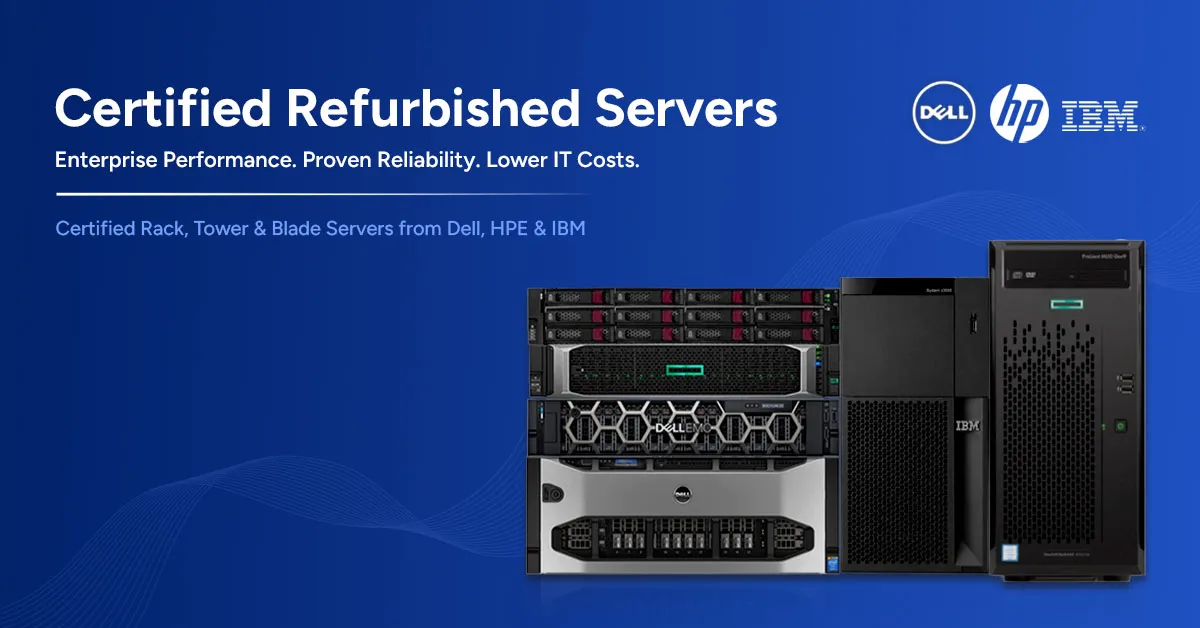
India's IT infrastructure market is growing at a pace that demands smart, cost-effective decisions. For businesses ranging from startups in Bengaluru to established enterprises in Mumbai and Delhi, investing in refurbished servers has become one of the most practical ways to build a powerful, scalable infrastructure without exhausting the entire IT budget. This blog walks you through everything you need to know from the fundamentals to the technical specifics so you can make an informed buying decision.
What Are Refurbished Servers?
A refurbished server is a pre-owned enterprise-grade server that has been professionally inspected, tested, repaired where necessary, cleaned, and certified to perform reliably before being resold. These are not broken machines sold as is. The refurbishment process is structured and rigorous every unit goes through hardware diagnostics, component replacement, firmware updates, and performance benchmarking before it is cleared for resale.
It is important to understand that refurbished servers are different from used or second-hand servers. A used server is sold with little to no intervention after it leaves its original owner. A refurbished server, on the other hand, meets defined quality benchmarks and often comes with a warranty, making it a much safer investment for business-critical operations.
Why Businesses in India Are Choosing Refurbished Servers
The demand for refurbished servers in India has grown considerably over the last several years, driven by a combination of budget constraints, rapid digital adoption, and growing awareness about sustainable IT practices. Businesses across sectors manufacturing, education, BFSI, and healthcare are recognising that they can achieve enterprise grade performance at a fraction of the cost of new hardware.
The cost advantage is a key consideration. Refurbished servers typically cost 40% to 70% less than their brand new equivalents, enabling businesses to deploy greater compute capacity within the same budget. However, cost is only one aspect. When properly tested and validated, these systems are suitable for a wide range of enterprise workloads, offering reliable performance, memory capacity, and storage capabilities aligned with operational requirements.
Environmental responsibility is another factor gaining traction. Using refurbished server hardware reduces electronic waste, extends the lifecycle of high-quality components, and aligns with the sustainability goals that many Indian businesses are now adopting as part of their corporate policies.
The Refurbishment Process - What Happens Before the Server Reaches You
Understanding what happens during the refurbishment process helps set realistic expectations and builds confidence in what you are purchasing. At Zaco computers, every refurbished server goes through a structured evaluation and restoration workflow before it is made available to customers.
Stage 1: Hardware Inspection and Diagnosis
Each server is physically inspected for signs of corrosion, physical damage, or component failure. Diagnostic tools are used to evaluate the health of processors, memory modules, storage controllers, power supplies, and cooling systems. Components that do not meet performance standards are replaced with genuine spare parts.
Stage 2: Component Cleaning and Replacement
Dust and contaminants are removed thoroughly from all server internals. Thermal paste is replaced, fans are tested for optimal RPM, and any failing or borderline components including HDDs, SSDs, RAID controllers, and memory sticks are swapped out with verified replacements.
Stage 3: Firmware and Software Baseline
Servers are updated to stable firmware versions. BIOS and management interfaces such as iDRAC, iLO, or IMM are configured and verified. Operating systems or hypervisors are wiped to a clean state, ensuring the buyer receives a machine with no legacy data or configurations.
Stage 4: Performance Testing and Certification
Before dispatch, each unit undergoes stress testing under simulated workloads. Performance benchmarks are recorded, and only servers that meet the predefined quality threshold are certified and made available for sale.
Types of Refurbished Servers Available at Zaco computers
Choosing the right form factor is one of the most important decisions when deploying server infrastructure. Each type has distinct characteristics suited to different environments and use cases. At Zaco computers, we stock all three major categories of refurbished servers - rack, tower, and blade sourced from leading global brands including Dell, HP, IBM, Cisco, and Fujitsu.
Rack Servers
Rack servers are mounted in standardised 19-inch server racks and measured in rack units (U). They are the most widely deployed server form factor in data centres, server rooms, and colocation facilities. Their modular design makes scaling straightforward you add more servers to the rack as your compute needs grow. Rack servers are ideal for medium to large enterprises that need to consolidate multiple workloads in a structured, manageable environment. Common use cases include virtualisation platforms, web hosting, database servers, and enterprise applications.
Refurbished rack servers from Zaco computers are available in 1U, 2U, and 4U configurations, supporting Intel Xeon and AMD EPYC processors, enterprise grade SAS and SATA storage, and ECC RAM.
Tower Servers
Tower servers resemble standard desktop towers but are purpose built for server workloads. They are standalone units that do not require a rack or specialised mounting hardware, making them an excellent choice for small offices, branch locations, and businesses that are setting up their first dedicated server. Tower servers are easier to manage for IT teams without advanced data centre infrastructure.
For growing businesses that need reliable compute power without the upfront investment in rack infrastructure, refurbished tower servers offer an accessible and cost-effective entry point.
Blade Servers
Blade servers are high-density computing solutions where multiple server blades are housed within a shared chassis. The chassis provides centralised power, cooling, and network connectivity, significantly reducing cabling complexity and power consumption per compute unit. Blade servers are designed for large-scale enterprise environments where space efficiency, high availability, and workload density are priorities.
Though blade servers represent a more complex deployment, their total cost of ownership over time especially when considering power and cooling savings makes refurbished blade servers particularly attractive for data centres and cloud service providers operating at scale.
Key Specifications to Evaluate When Buying Refurbished Servers
Not all refurbished servers are built the same, and buying the right one requires a working understanding of the core technical specifications that drive performance. Whether you are procuring servers for a small business application or an enterprise virtualisation stack, these are the parameters you must evaluate carefully.
- Processor (CPU): Look for Intel Xeon Scalable or AMD EPYC processors with a core count and clock speed appropriate for your workload. Multi-socket platforms offer greater parallel processing capability for demanding applications.
- Memory (RAM): Enterprise servers use ECC (Error Correcting Code) RAM, which detects and corrects memory errors automatically, a critical feature for database and virtualisation workloads. Evaluate total memory capacity and the number of available DIMM slots for future expansion.
- Storage Configuration: Consider whether your workload benefits more from high speed SAS/SSD drives for IOPS intensive tasks or high capacity SATA drives for bulk storage. RAID controller compatibility is equally important for data redundancy.
- Network Interface Cards (NICs): For high throughput applications, 10GbE or 25GbE NICs are preferable. Verify the NIC configuration against your network infrastructure to avoid bottlenecks.
- Power Supply and Redundancy: Hot-swappable, redundant power supply units (PSUs) are essential for servers handling mission critical workloads. Check the wattage rating against your expected power draw.
- Remote Management: Built-in management interfaces such as Dell iDRAC, HP iLO, and IBM IMM enable out of band server management, allowing your IT team to monitor and troubleshoot systems remotely without physical access.
Performance and Reliability - Addressing the Common Concerns
The most frequent hesitation among first time buyers of refurbished servers is around reliability. This concern is understandable, but it is largely unfounded when the refurbishment process is thorough and transparent. The average enterprise server has a designed lifespan of seven to ten years. Most refurbished units entering the secondary market are retired by large corporations after three to five years of use well within their operational life as part of standard refresh cycles. This means the hardware is mature, well documented, and still has years of reliable service remaining.
Modern server hardware is built to withstand continuous operation under demanding conditions. The failure rates of properly tested refurbished servers are comparable to new hardware especially when faulty components have been identified and replaced during the refurbishment process. The key differentiator is the quality of refurbishment and the transparency of the testing process.
What Workloads Are Refurbished Servers Suitable For?
Refurbished servers are a strong fit for a wide range of real world enterprise workloads. The following applications are particularly well suited to refurbished server deployments:
- Virtualisation environments using VMware vSphere, or Microsoft Hyper-V
- Database servers running MySQL, PostgreSQL, Microsoft SQL Server, or Oracle
- Web hosting, application hosting, and content delivery infrastructure
- Development, testing, and staging environments for software teams
- Enterprise backup and disaster recovery systems
- Edge computing deployments and remote office infrastructure
- Private cloud and hybrid cloud on premises nodes
Refurbished Servers vs New Servers - Comparison
The decision between refurbished and new hardware is rarely black and white. It depends on the specific workload, budget available, and the support structure in place. That said, for the majority of standard enterprise workloads, refurbished servers offer an excellent balance of performance, reliability, and cost efficiency.
A new server from a leading OEM like Dell or HP carries a significant price premium largely driven by the cost of brand new components, OEM margin, and the features of the latest-generation chipsets. In many cases, those cutting-edge features such as PCIe 5.0 support or the very latest generation CPU are not required to run current enterprise applications effectively. A previous generation server with proven components can deliver equivalent real-world performance for most workloads at a substantially lower acquisition cost.
Where new servers have a clear advantage is in long-term OEM support windows, access to the latest firmware security patches immediately after launch, and warranty coverage. However, reputable refurbished server suppliers bridge this gap significantly by offering extended warranties, post-sale technical support, and access to genuine spare parts making the lifecycle economics considerably more comparable.
Not sure whether new or refurbished is the right fit for your IT project?
Zaco computers technical team can help you assess your workload requirements and recommend the most cost-effective configuration. Contact us at zaco computers for an expert consultation.
Buying Refurbished Servers in India - What to Look for in a Supplier
The quality of your refurbished server purchase depends heavily on the credibility and processes of the supplier you choose. India's growing IT hardware resale market includes a wide range of vendors, and not all of them adhere to the same standards of testing and transparency. Before making a purchase, evaluate potential suppliers against the following criteria:
- Certification and Testing Documentation: A credible supplier provides detailed testing reports or certificates for each unit, outlining the components replaced, diagnostics performed, and benchmark results recorded.
- Warranty Coverage: Look for a minimum of 90 days warranty on refurbished hardware, with clarity on what is covered and the process for claims. Longer warranty periods six months to one year indicate higher supplier confidence in their products.
- Genuine Spare Parts: Ensure that the supplier sources replacement components from authorised channels. Using compatible third-party parts is acceptable, but counterfeit or substandard components undermine reliability.
- After-Sales Technical Support: Post-purchase support is critical for server deployments. The supplier should have a technical team capable of assisting with configuration, troubleshooting, and on-site or remote support when needed.
- Inventory Breadth and Customisation: A supplier with a wide range of brands, form factors, and configurations and the ability to customise memory, storage, and processor options gives you flexibility to match hardware to your exact requirements.
Zaco computers - Your Trusted Partner for Refurbished Servers in India
At Zaco computers, we have built our reputation around one principle: delivering enterprise-grade IT hardware that businesses can depend on. Our inventory covers a comprehensive range of refurbished servers from industry leading brands Dell, HP, IBM, Cisco etc. across all major form factors including rack, tower, and blade configurations.
Every refurbished server in our catalogue undergoes a multi-stage quality process before it reaches you. Our in-house technical team handles diagnostics, component level repair, firmware baseline, and performance certification. We stock genuine spare parts across a wide range of server platforms, which means that post-sale support and component level repairs are handled quickly and reliably without extended lead times.
Beyond servers, Zaco computers supplies a full range of complementary IT hardware including enterprise SSDs, HDDs, server memory, power supply units, and spare parts making us a single source solution for your infrastructure needs.
Ready to upgrade your infrastructure with certified refurbished servers?
Visit zaco computers to explore our current inventory of rack, tower, and blade servers or speak directly with our IT hardware specialists to configure the right solution for your business. We serve customers across India, with remote support for the UK and UAE markets.
Conclusion
Refurbished servers represent one of the most practical investments available to Indian businesses looking to build or expand their IT infrastructure without overspending. When purchased from a credible, process driven supplier, they deliver enterprise-grade performance, proven reliability, and significant cost savings all within a sustainable approach to hardware consumption.
The key is to look beyond the price tag. Evaluate the supplier's refurbishment standards, warranty terms, after sales support capability, and inventory depth. Understand the form factor and specifications that align with your workload. When you approach the purchase with that level of diligence, refurbished servers are not a compromise they are a strategic advantage.
Whether you are deploying your first server or scaling an established data centre, Zaco computers provides the hardware, expertise, and support to make that journey straightforward. Explore our range of refurbished servers at zacocomputer.com and take the next step in building an infrastructure your business can rely on.
Frequently Asked Questions (FAQs)
Q.1 Are refurbished servers reliable enough for production workloads?
Yes, when sourced from a reputable supplier that follows a structured refurbishment process, refurbished servers are entirely suitable for production environments. Most units entering the secondary market are retired after three to five years of corporate use, well within their designed operational lifespan of seven to ten years. Rigorous testing, faulty component replacement, and firmware updates ensure the hardware performs consistently under real-world workloads such as virtualisation, database management, and web hosting.
Q.2 What is the difference between a refurbished server and a used server?
A used server is sold in its existing condition with minimal or no intervention what you see is what you get, including any existing wear or faults. A refurbished server, on the other hand, has been professionally inspected, diagnosed, repaired, cleaned, and certified to meet defined performance standards before resale. Refurbished servers typically come with a warranty, providing significantly more assurance than a straightforward second hand purchase.
Q.3 Which server form factor rack, tower, or blade is best?
It depends on your environment and scale. Tower servers are best suited for small to medium businesses with limited IT infrastructure, as they require no specialised mounting hardware. Rack servers are ideal for medium to large organisations with a structured server room or data centre, offering excellent scalability and manageability. Blade servers are the right choice for large enterprise and data centre environments where maximum compute density, centralised resource sharing, and power efficiency are priorities. Zaco computers team can help assess your specific requirements and recommend the appropriate form factor.
Q.4 Do refurbished servers come with a warranty?
Yes, reputable refurbished server suppliers provide warranty coverage on their products. At Zaco computers, our refurbished servers come with warranty support, and our technical team is available to assist with hardware replacements or troubleshooting within the warranty period. Always confirm the warranty terms including what is covered and the claims process before making a purchase, as warranty coverage is a strong indicator of the supplier's confidence in the quality of their refurbishment process.
Q.5 Can refurbished servers be customised with specific RAM, storage, or processor configurations?
Yes, one of the practical advantages of buying refurbished servers from a specialist supplier is the ability to configure the hardware to your exact requirements. At Zaco computers, we offer customisation across memory, storage type and capacity, processor selection, RAID configuration, and NIC specifications. This ensures the server is matched to your specific workload rather than accepting a fixed out of the box configuration that may over provision in some areas and underperform in others.
Q.6 What brands of refurbished servers does Zaco computers stock?
Zaco computers maintains inventory across leading enterprise server brands including Dell (PowerEdge series), HP/HPE (ProLiant series), IBM, and Lenovo. Our range covers rack, tower, and blade form factors in various generations and configurations. In addition to servers, we supply hardware including enterprise SSDs, HDDs, server memory, power supply units, and spare parts providing a comprehensive IT hardware solution from a single trusted source.