

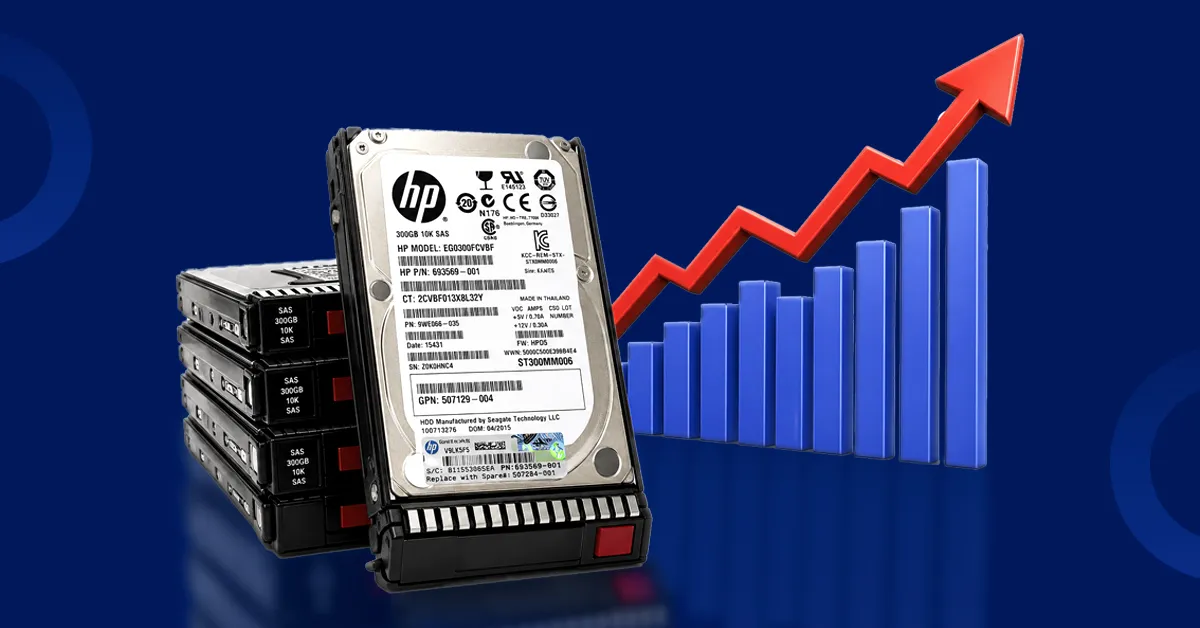
Enterprise IT procurement teams are dealing with a market reality that is difficult to budget around: the cost of new server storage hardware has climbed significantly, and HP server hard drives are no exception to this trend.
For businesses running HPE ProLiant infrastructure, a failed or ageing drive replacement that was once a routine budget line is now a more considered purchase. This article breaks down what is driving the price pressure, what HP server hard drives are available for enterprise workloads, and why refurbished HDD stock has become the most practical cost management tool available to IT teams today.
What Is Driving HP Server Hard Drive Price Increases?
The HDD market experienced its largest quarter-over-quarter price increase in eight consecutive quarters during Q4 2025, with contract prices jumping roughly 4% in a single quarter. That trend has not reversed; suppliers have signalled that upward pressure will persist through 2026.
Several forces are driving this simultaneously, and together they are squeezing enterprise storage budgets from multiple directions.
Source : contract prices rising by approximately 4% in Q4 2025 — the largest jump in eight quarters
AI Infrastructure Demand
The rapid expansion of AI data centres is driving a significant increase in global storage demand. Hyperscale cloud providers such as Microsoft, Amazon, and Alphabet are collectively investing hundreds of billions of dollars annually into AI and data centre infrastructure.
As AI workloads generate and process massive volumes of data, the need for high-capacity storage particularly nearline HDDs has grown substantially. Industry analysis from Trend Force indicates that data centre expansion and AI-driven workloads are placing sustained pressure on storage supply chains.
This surge in demand, combined with already high manufacturing utilisation, has created a supply-demand imbalance that continues to push HDD pricing upward across enterprise and cloud segments.
DRAM Cost Impact on HDD Manufacturing
Hard drives rely on DRAM for cache memory. With high-bandwidth memory and enterprise DRAM already in short supply due to AI chip demand, elevated DRAM costs flow directly into HDD manufacturing costs even before the drives reach the distribution channel.
Supply Chain Concentration
The global HDD market is supplied by just three manufacturers. That concentration makes pricing highly sensitive to any demand surge or regional supply disruption. When one segment such as cloud nearline storage experiences a demand spike, it pulls capacity away from enterprise and server-grade drives with minimal warning.
China Procurement Policy Shifts
Government procurement policies favouring domestically produced hardware in China have triggered a surge in local PC production. Unexpectedly, this has also accelerated HDD adoption in that market, adding volume pressure to an already strained supply chain.
The net result for enterprises: new HP hard drives cost more, lead times are longer, and budget planning that relied on stable pricing no longer holds.
Understanding HP Server Hard Drive Types and Their Enterprise Use Cases
HPE manufactures hard drives across two primary categories Enterprise (Mission-Critical) and Business Critical with interface and form factor choices that match specific workload requirements. Selecting the wrong type for a workload results in either overspending or performance shortfalls. Understanding each category is a practical procurement decision.
SAS Hard Drives: Performance and Mission-Critical Workloads
SAS (Serial Attached SCSI) drives are the standard for high-availability, performance-sensitive enterprise environments. HPE's SAS portfolio runs at 10,000 RPM or 15,000 RPM, with dual-port redundancy for continuous operation. The 12Gbps SAS interface delivers substantially higher throughput and lower latency than SATA.
SAS drives are the right choice for database servers, virtualisation hosts, ERP systems, and any workload where IOPS and response time directly affect application performance. They are designed for 24x7 continuous operation in demanding data centre environments.
SATA Hard Drives: Cost-Effective Bulk and Archive Storage
SATA HP server hard drives operate at 6Gbps and are optimised for capacity over speed. Running at 7,200 RPM, they offer a significantly lower cost per terabyte compared to SAS, making them the correct choice for backup targets, archive storage, log retention, and secondary data tiers where throughput is not the primary requirement.
For mixed storage architectures where performance tiers use SAS or SSD and capacity tiers use SATA - SATA drives handle the bulk storage role efficiently at substantially lower unit cost.
Form Factors: 2.5" SFF vs. 3.5" LFF
HPE server hard drives are available in two form factors. The 2.5-inch Small Form Factor (SFF) is standard in rack and blade servers where density matters more drives fit within the same chassis footprint. The 3.5-inch Large Form Factor (LFF) is common in tower servers and storage systems where maximum capacity per unit is the priority.
Compatibility between form factor and server chassis is non-negotiable. HPE ProLiant G8, G9, and G10 generations each have specific drive bay and carrier specifications. Verifying compatibility before procurement avoids the costly mistake of receiving drives that do not physically fit or are not recognised by the storage controller.
Key Specifications to Verify Before Buying HP Server Hard Drives
Enterprise HP hard drives carry OEM part numbers that specify their exact configuration. Buying to part number rather than to generic specification is the most reliable way to ensure compatibility with HPE ProLiant servers and storage arrays.
- Interface and speed: SAS 12Gbps for mission-critical workloads; SATA 6Gbps for nearline and archive storage.
- RPM rating: 15K RPM for the lowest latency; 10K RPM for the standard enterprise performance-to-cost balance; 7.2K RPM for high-capacity nearline applications.
- Form factor: 2.5" SFF for rack and blade servers; 3.5" LFF for tower and storage enclosures.
- Server generation compatibility: HPE drives are firmware-validated per server generation. A G8-compatible drive and a G10-compatible drive may share the same physical connector but behave differently due to firmware and carrier differences.
- Carrier type: HPE uses Smart Carrier (SC) for newer ProLiant generations and Basic Carrier (BC) for older platforms. The carrier is part of the drive assembly, not a separate accessory.
When sourcing refurbished HP server hard drives, these specifications should appear explicitly on the product listing. Part numbers such as 619463-001, 653955-001, or 507284-001 directly communicate all of the above parameters, verifying them against HPE's Quick Specs documentation takes minutes and eliminates compatibility risk.
Why Refurbished HP Server Hard Drives Are a Credible Enterprise Solution
The refurbished server hardware market has evolved into a reliable option for enterprises. What was once approached cautiously is now widely accepted by cost-conscious infrastructure teams especially for storage, where most workloads do not require the latest-generation drives.
The Reliability Case
Enterprise-grade HP hard drives are built for continuous 24×7 data centre operation, with a typical lifespan of five or more years. Most refurbished drives come from enterprise refresh cycles after just three to four years, meaning they still have significant usable life remaining.
When subjected to rigorous diagnostics such as SMART analysis, read/write testing, sector checks, and firmware validation these drives can deliver performance comparable to new drives of the same specification.
The Cost Advantage
Refurbished HP hard drives are typically 40% to 70% cheaper than new OEM drives. With rising HDD prices, this cost gap continues to grow. For organisations managing large-scale storage or maintaining legacy systems, these savings add up quickly.
This cost benefit applies across use cases, including primary storage, RAID expansion, hot spares, and replacement drives for older servers.
The Sustainability Dimension
Using refurbished HP hard drives extends the lifecycle of high-quality components and reduces electronic waste. For organisations with ESG goals, it offers a practical way to support sustainability while maintaining operational efficiency.
What to Look for When Buying Refurbished HP Server Hard Drives
Not all refurbished drives are processed to the same standard. The quality of refurbishment varies significantly between suppliers, and the due diligence checklist for purchasing HP hard drives in refurbished condition is short but critical.
- Diagnostics documentation: The supplier should be able to confirm that each drive has passed SMART diagnostics, read/write cycle testing, and sector verification before being offered for sale.
- Firmware currency: Drive firmware should be validated against the target server generation. Outdated firmware can cause compatibility issues with HPE storage controllers and management tools.
- OEM part number accuracy: Look for listings that specify the HPE OEM part number, not just generic descriptions. The part number confirms interface, form factor, RPM, capacity, and server generation compatibility in one reference.
- Warranty coverage: A responsible refurbished drive supplier offers warranty coverage as standard not as an optional extra. Warranty terms give you recourse if a drive fails within the coverage period.
- Supplier track record: Enterprise storage is not a segment where saving a small amount by buying from an unknown source is worth the operational risk. Verify that the supplier has a demonstrable record of supplying refurbished IT hardware to enterprise customers.
HP Server Hard Drives Available at Zaco Computer
Zaco Computer maintains an active inventory of refurbished HP server hard drives spanning the most commonly deployed HPE ProLiant server generations. Our stock covers the full range of enterprise drive specifications from high-speed 15K SAS drives for performance-critical applications to high-capacity nearline SATA drives for bulk storage.
SAS Drive Range
Our SAS inventory includes 2.5" hot-plug drives at 300 GB, 450 GB, 600 GB, 900 GB, 1.2 TB, and 1.8 TB capacities available in both 6Gbps and 12Gbps interface configurations. Speeds range from 10K RPM for the standard enterprise balance to 15K RPM for the lowest-latency requirements.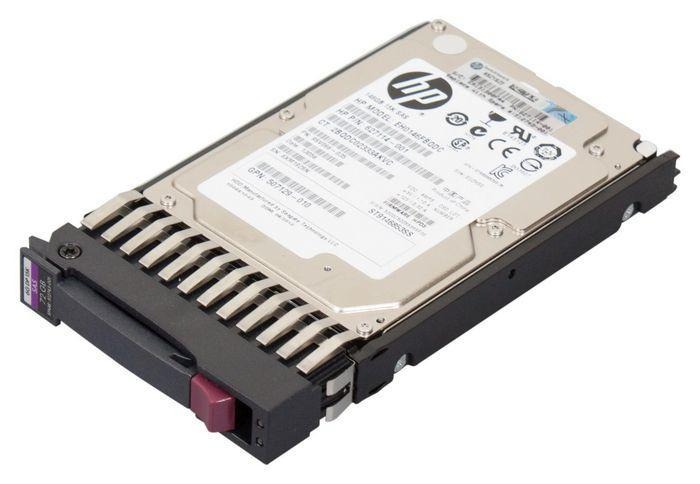
All SAS drives are listed with full HPE part numbers and confirmed server generation compatibility. Whether you are replacing a failed drive in an existing RAID array or expanding storage on a ProLiant DL360, DL380, or BL460c platform, our team can confirm the right part before dispatch.
SATA Drive Range
Our SATA inventory covers the nearline and bulk storage segment, with 2.5" and 3.5" drives at 1 TB, 2 TB, 4 TB, and larger capacities, operating at 7.2K RPM. These are matched to HPE ProLiant G8 through G10 platforms and are suitable for backup targets, secondary data tiers, and archive storage.
Procurement Support for Larger Orders
For enterprises requiring multiple drives for RAID expansion, hot-spare replenishment, or fleet-wide storage upgrades Zaco Computer provides part-matching support and bulk pricing on request. Our teams across India, the United Kingdom, and the UAE support enterprises with configuration guidance and compatibility verification prior to procurement.
For customers in the UK and UAE, Zaco Computer ensures consistent, high-quality remote support aligned with local expectations, delivered with the efficiency and cost advantages of a global sourcing model.
Ready to reduce your HPE storage costs with certified refurbished drives?
Explore Zaco Computers certified refurbished HPE hard drive inventory or call +91 22 6928 8800 to speak with our hardware team about part matching, bulk pricing, and delivery timelines.
Conclusion
The surge in HP server hard drive prices is not a short-term anomaly. With AI infrastructure demand driving sustained pressure on storage supply chains, enterprise DRAM costs feeding into HDD manufacturing, and a highly concentrated supplier base, the price environment for new server storage hardware is unlikely to ease in the near term.
For enterprises managing HPE ProLiant infrastructure, refurbished HP hard drives represent the most practical and immediate response to this cost pressure. When sourced from a supplier with documented testing processes, accurate OEM part numbers, and warranty coverage, refurbished drives deliver the same reliable performance as new hardware at 40% to 70% lower cost.
Zaco Computer's refurbished HPE hard drive inventory is available now, covering SAS and SATA drives across the G8, G9, and G10 server generations. Browse the full range at zacocomputer.com/shop/hpe/hpe-hard-drive/ or contact our team directly for part-matching and procurement support.
Frequently Asked Questions (FAQs)
Q1. Are refurbished HP server hard drives reliable for production environments?
Yes, when properly tested. Enterprise HPE server hard drives are built for continuous 24x7 operation over five or more years. Most refurbished units enter the secondary market after three to four years of corporate use, well within that lifespan. Full diagnostics, SMART verification, and firmware validation before resale ensure they perform reliably in production.
Q2. What is the difference between SAS and SATA HP hard drives?
SAS drives offer higher speed (10K–15K RPM), dual-port redundancy, and 12Gbps throughput suited for databases, virtualisation, and high-IOPS workloads. SATA drives run at 7.2K RPM with 6Gbps throughput, delivering higher capacity at lower cost for backup, archive, and secondary storage tiers.
Q3. How do I confirm which HPE hard drive is compatible with my server?
Check the HPE OEM part number against your server model's Quick Specs documentation. Key parameters are interface (SAS/SATA), form factor (2.5" SFF or 3.5" LFF), carrier type (Smart or Basic), and server generation (G8, G9, G10). Zaco Computer's team can assist with part matching on request.
Q4. How much can I save by buying refurbished HP hard drives?
Refurbished HP hard drives typically cost 40% to 70% less than new OEM equivalents at current market pricing. With new HDD prices continuing to rise due to AI infrastructure demand and supply chain pressure, the savings gap between new and refurbished is widening.
Q5. Do refurbished HP server hard drives come with a warranty?
At Zaco Computer, our refurbished HP server hard drives are supplied with warranty coverage as standard. Warranty terms are confirmed at purchase. If a drive fails within the covered period, our team handles replacement or resolution promptly.
Q6. Why are HP server hard drive prices increasing in 2025 and 2026?
Three factors are driving the increase: surging demand from AI data centre expansion consuming storage at record scale; elevated DRAM costs flowing into HDD manufacturing; and a supply chain served by only three global manufacturers, leaving little buffer against demand spikes. HDD contract prices rose roughly 4% in Q4 2025 alone the largest single-quarter increase in eight quarters.